




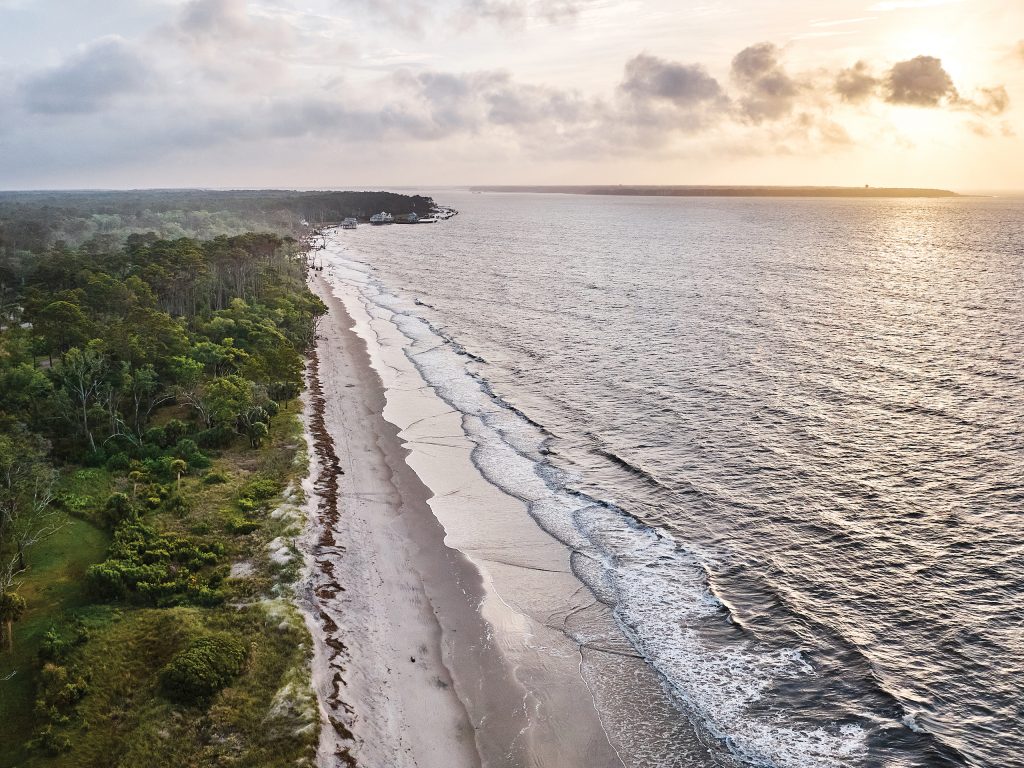
It makes for a pleasant day trip, true, but there’s so much more to this South Carolina sea island.
Written by Kiki Dy
Photography by Blake Crosby/Crosby Creative
Marine ecosystems can vary dramatically within mere meters of depth. A section of satin sea at sunset or waves of choreographed chaos in a storm, though seemingly synchronized, hold different rituals, worlds, and unknowns beneath the froth.
Daufuskie Island, for visitors, works much the same way. The South Carolina sea island is often depicted with images from travel mags — a styrofoam cup held by a man with a sunburned chest in a golf cart, a festive group photo taken at Old Daufuskie Crab Co., a peaceful moment showing an egret-abundant bird rookery.
But it has also been recently lauded by travel writers as “a throwback to a slower coastal South,” “an unspoiled barrier island,” and “an untouched oasis,” which are also apt descriptors.
As Daufuskie increasingly lands on tourist radars, there’s an opportunity for understanding the island in a deeper way.
Getting To and Around the Island
Part of Daufuskie’s contemporary appeal is that it’s Uber-proof.
Most visitors arrive via private boat or passenger ferry from Hilton Head Island or Bull River Marina on Wilmington Island, crossing waterways that have connected Savannah, Hilton Head, and Daufuskie for generations. Depending on the route, the trip typically takes between 30 and 45 minutes.
For island residents, however, the ferry is not a novelty; it’s a necessity. With no bridge to the mainland, Daufuskie residents rely on regular ferry service for work, medical appointments, shopping, and everyday errands. Middle and high school students still commute to Hilton Head by boat each day before continuing on to school by bus, a journey that takes more than an hour each way.
Ferry schedules vary by operator and season, but multiple daily crossings help keep the island connected while preserving the sense of remove that draws many visitors in the first place.
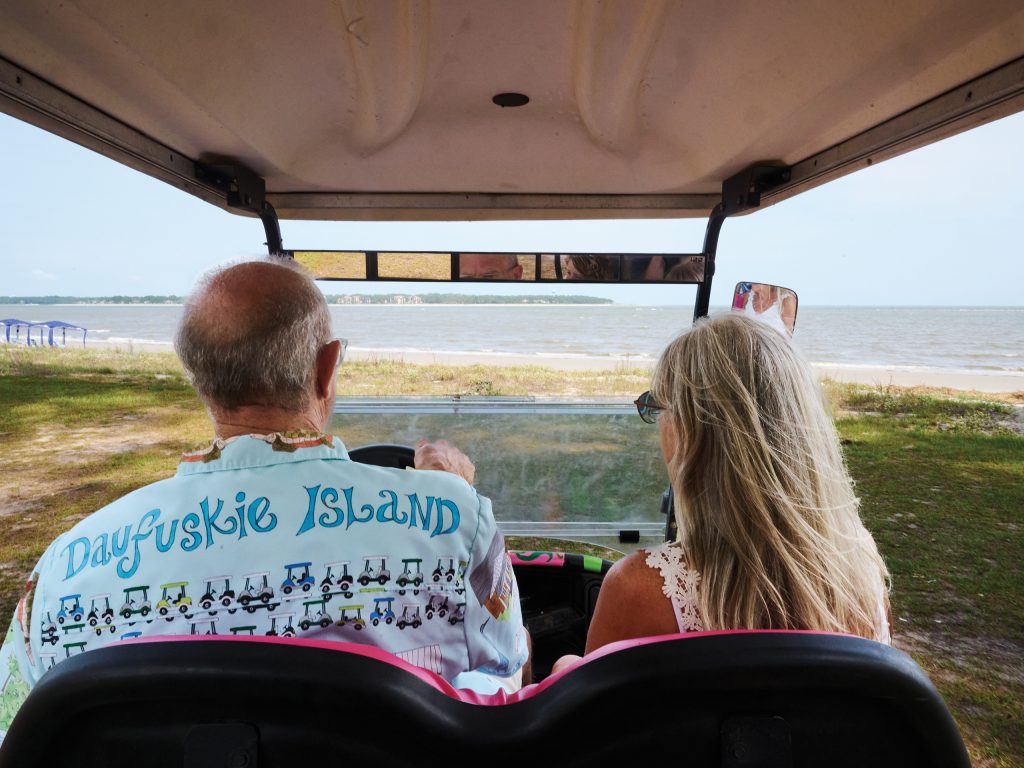
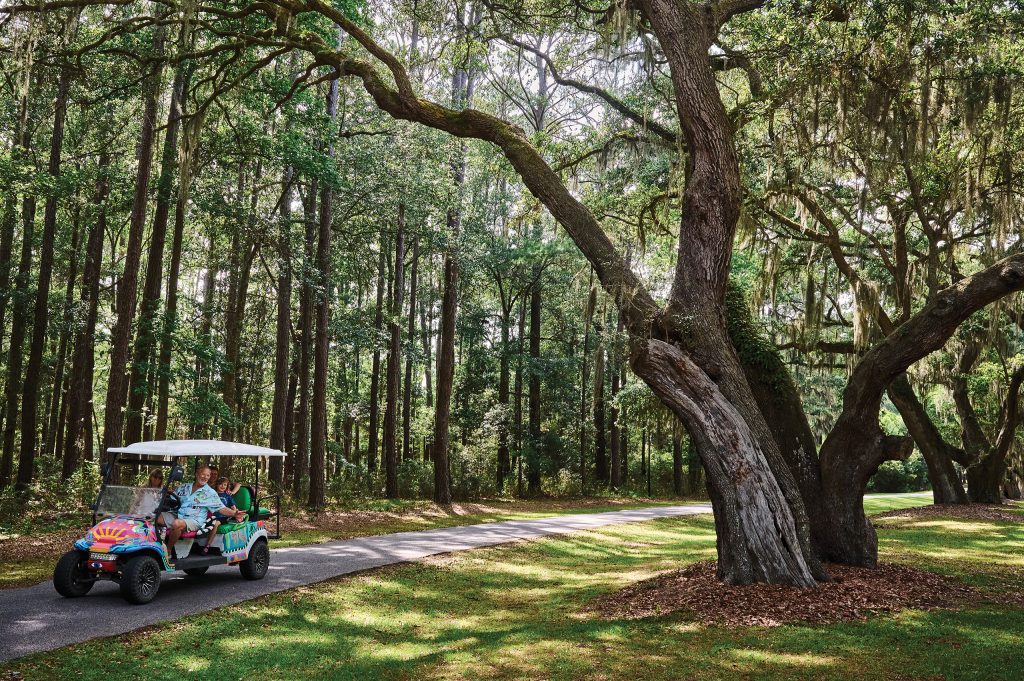
Once ashore, visitors will find that golf carts have become the island’s default mode of transportation, and today, several companies offer both traditional and electric rentals. Bicycles remain another popular option, particularly for visitors interested in absorbing and meandering.
Daytrippers: Pay close attention to return ferry times, lest you miss the last boat back for the day.
Island Allure
Daufuskie’s distance from mainland areas once underpinned the island’s society rather than inviting sojourn. The same waterways that now lure adventurous outsiders created the conditions for one of the region’s most enduring Gullah Geechee communities to evolve language, traditions, and terms of existence.
Less than a mile of water separates Daufuskie from Hilton Head, yet the island remains accessible only by boat. That’s part of the allure: Daufuskie’s inimitable sense of arrival is worthwhile on its own.
Arriving at Freeport Marina, Old Daufuskie Crab Co. comes into focus as one pulls into the dock. Live music and boater bacchanalia against an unblemished biome make for a distinct interplay that’s unforgettable.
“One of our key takeaways was abundance — or even excess compared to our relatively barren European landscapes,” says one visitor we interviewed, Jonathan Lasham. He is a biophysicist visiting from Finland, and he and his partner, Adam Smith, found the lush environment “almost too much to process.”
While this might be true for a Scandinavian, we suspect most Coastal Empire folks can handle it.
What to Read Before You Go
For generations, many Gullah children were told that their language was something to overcome. As Gullah Kinfolk Traveling Theater deputy and musical director Scott Gibbs recalls, “We were taught that we weren’t supposed to speak Gullah because it wasn’t ‘correct.’”
The books below are reminders that language, stories, recipes, folklore, and memory are worth carrying forward. Some are about Daufuskie Island. Others are not. Together, they offer a wider lens into the communities, traditions, and histories that continue to shape the Gullah Geechee world.
FOR THE KIDS: “The Gathering Table” by Antwan Eady
Celebrated Savannah-based author Antwan Eady’s book “The Gathering Table” introduces young readers to Gullah Geechee traditions through the eyes of a child anticipating a family gathering. The vibrantly illustrated, joyous tale narrates how the culture builds and binds community.
“Visiting Gullah communities, in so many ways, offers a window into the living legacy of a distinct African-rooted culture,” Eady says. “We tell the stories of cultural survival in America through our food, art, craft, music, spiritual expressions, and language.”
For Eady, children’s literature is part of that preservation work. “The fight isn’t over,” he says, “and it’s all of our responsibility to preserve such a rich history.”
FOR THE FOLKLORIST: “Gullah Animal Tales from Daufuskie Island, South Carolina” by Albert Henry Stoddard
Long before cultural preservation became a formal undertaking, stories carried knowledge between generations. This collection gathers animal tales rooted in Gullah oral tradition — stories that entertain, certainly, but also preserve language, humor, values, and worldviews.
That distinction matters to Gibbs, who cautions against reducing Gullah Geechee culture to a single narrative or representative voice.
“No one person can tell the one story because everyone’s experience was different,” Gibbs says. “Many of us are out there.”
FOR THE LITERARIAN: “The Water is Wide” by Pat Conroy
Pat Conroy’s 1972 memoir “The Water Is Wide” is based on his experience teaching for a year
on Daufuskie Island. (In the book, it’s called Yamacraw Island).
Well-known Daufuskie resident Sallie Ann Robinson was a student of Conroy’s and appears in the book’s pages as the character named Ethel.
Decades later, Conroy would write the foreword to Robinson’s cookbook “Gullah Home Cooking the Daufuskie Way,” creating a full-circle moment. The book was also turned into a movie, “Conrack,” starring Jon Voight.
Stories in this Feature
Daufuski Island: Deep & Wide: It makes for a pleasant day trip, true, but there’s so much more to this South Carolina sea island.
Total Island Immersion: Excursions and accommodations that take you deep into Daufuskie’s ecology, history, and culture.
The Faces and Places of Daufuskie: A few home-grown businesses that represent the quintessential nature of island life.
The Legacy of Daufuski Island: A museum complex of three historic buildings ensures the island’s history isn’t forgotten.