
A museum complex of three historic buildings ensures the island’s history isn’t forgotten.
Written by Mary Cornetta
Photography by Blake Crosby/Crosby Creative
Set along a quiet stretch of Old Haig Point Road, the Daufuskie Island History Museum continues to preserve the island’s legacy through personal mementos, restored structures, and the stories of the people who shaped it throughout generations.
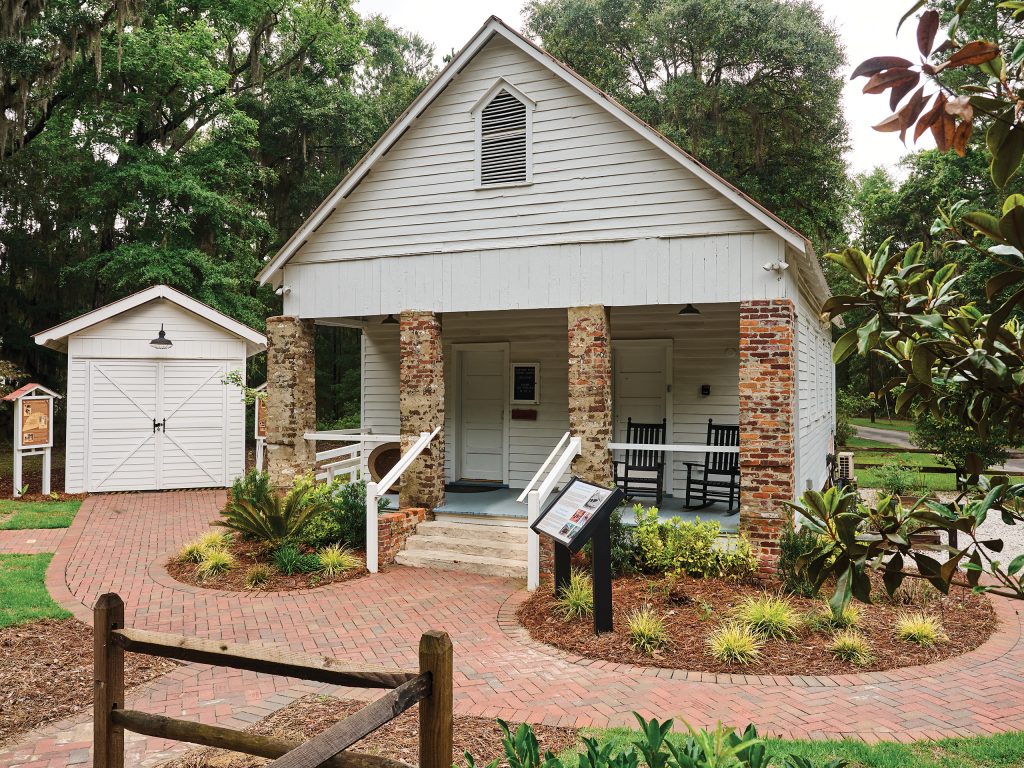
Operated by the Daufuskie Island Historical Foundation, led by president Geoff Brunning, the museum complex consists of three historic buildings: a carriage house, the former Jane Hamilton School, and the former Mount Carmel Baptist Church No. 2, where exhibits reside. “The selection of the church building to house the museum was an easy one,” says Sam Waters, historian and vice president of the foundation. “It provided an opportunity to restore and preserve an important part of Daufuskie history while creating an ideal space for exhibiting the artifacts and treasures that document the island’s history over time.”
Stories in this Feature
Daufuski Island: Deep & Wide: It makes for a pleasant day trip, true, but there’s so much more to this South Carolina sea island.
Total Island Immersion: Excursions and accommodations that take you deep into Daufuskie’s ecology, history, and culture.
The Faces and Places of Daufuskie: A few home-grown businesses that represent the quintessential nature of island life.
The Legacy of Daufuski Island: A museum complex of three historic buildings ensures the island’s history isn’t forgotten.
The main museum building — a wooden church originally constructed by residents of Daufuskie’s north end — dates back to the years following a devastating 1940 hurricane. The island’s original Mount Carmel Baptist Church, built in 1901, was destroyed in that storm, prompting residents to rebuild shortly afterward on a nearby site (hence, church No. 2).
As the island’s population declined over time, the church eventually closed. In 2001, the Historical Foundation purchased and restored the property, transforming it into the place both locals and visitors can witness today. Inside, exhibits trace Daufuskie’s history from its earliest Native American inhabitants through Spanish exploration, English settlement, the plantation era, the Civil War, and beyond. Yet some of the museum’s most compelling displays focus not on significant historical events, but on the everyday people whose lives shaped the community.
“Several displays feature some of the notable Gullah residents of the island in more recent times,” explains Waters. Among them are the prominent home builder Samuel Holmes and longtime resident Cleveland Bryan, who recently celebrated his 101st birthday. Visitors can also view a Gullah Bible, illustrating the church’s enduring spiritual and cultural significance. The original pulpit and organ also remain well-preserved, with the restored organ still fully functional.
Just outside the museum sits one of the foundation’s most treasured relics: the carriage once used by Sarah Grant, Daufuskie Island’s last midwife. Built in 1893 by the Chatham Carriage Co. in Savannah, the spindle-back carriage helped Grant deliver 130 babies between 1932 and 1969. The fact that she didn’t lose a single child was a remarkable accomplishment made even more extraordinary by the island’s isolation and lack of medical facilities during much of the 20th century. “When Sarah was notified that a woman was in labor, she gathered up her supplies, hitched her horse, Tillman, to this carriage, and headed off to provide her services,” Waters says. “After her retirement, women had to go to maternity facilities across the water.”
Inside the museum, some of Grant’s original midwifery supplies remain on display, helping visitors imagine the realities of island life before bridges, ambulances, and nearby hospitals. But her influence extended well beyond childbirth. According to Waters, Grant also worked as an oyster shucker; served as a deaconess, Sunday school teacher, and choir member at the First Union African Baptist Church; led the PTA; managed local election boxes; and finally took over her husband’s job as an undertaker after his passing. She was known as Daufuskie’s unofficial mayor. She died in 1977, “leaving behind an enduring legacy and a generation of island residents whose lives literally began with her care,” Waters says.
Preserving the carriage itself became a major undertaking for the foundation. After an extensive search for qualified restorers, it was eventually sent to Pennsylvania in 2015, where Amish carriage builder Paul Stoltzfus completed the restoration work. A dedicated carriage house was later constructed in 2016 by Mike Vaccaro of Ludtke & Vaccaro Architects in Bluffton. It helps safely preserve what Waters believes is the oldest vehicle on Daufuskie Island.
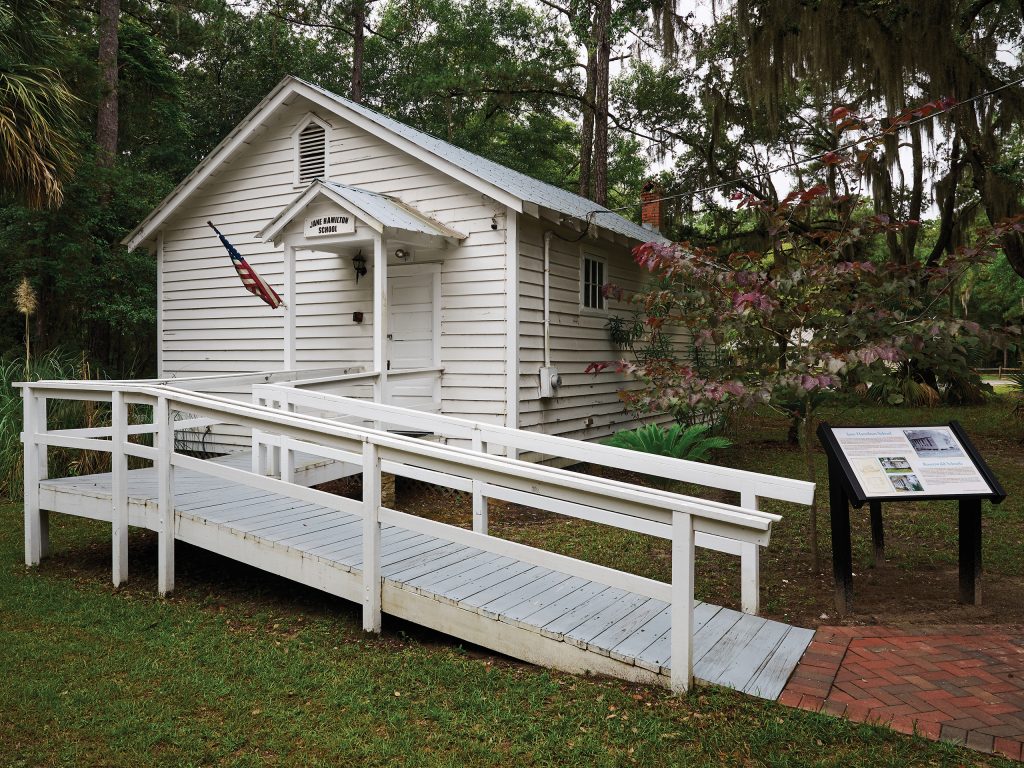
Another significant stop on the museum campus is the former Jane Hamilton School. Named for Gullah resident Jane Hamilton, who donated the land for the school in 1938, the building reflects an important chapter in educating young Black residents during the era of segregation. The school has large windows to provide natural light and a better learning environment, according to Waters.
After the oyster industry declined and enrollment dropped, the school (nicknamed “the Janie” by locals) closed in 1950. Hamilton later made the building her home until her death in 1961 at the age of 94. Today, after restoration efforts by the Historical Foundation, it serves multiple roles for the community, including as a public library, polling place, and cultural center dedicated to preserving Gullah history and traditions.
For museum guests, it offers something increasingly hard to find in the modern world: a chance to experience history in a setting that still feels fiercely rooted to its past. “We would hope that visitors leave with a sense that Daufuskie is a small island with a large history,” Waters says. “Due to the isolation that the island has always enjoyed, Daufuskie remains just a bit closer to its history than most places.”
The foundation is also committed to looking toward the future. Waters says ongoing efforts include expanding the museum’s digital presence through social media and online educational resources that enable people both on and off the island to dive deeper into Daufuskie’s history. The organization also hopes to make more of its archival materials — including land grants, surveys, and historical correspondence — accessible to the public, while developing an audio tour that will allow visitors to experience the museum in a more immersive way.
Despite embracing today’s technology, the Daufuskie Island History Museum remains one of the most captivating ways to revisit the past. “We have no traffic jams, no overcrowded beaches or tourist attractions, no late-night lights or noise, and no condensed retail shopping areas,” Waters says. “It is far easier to get a sense of what once was here.”