



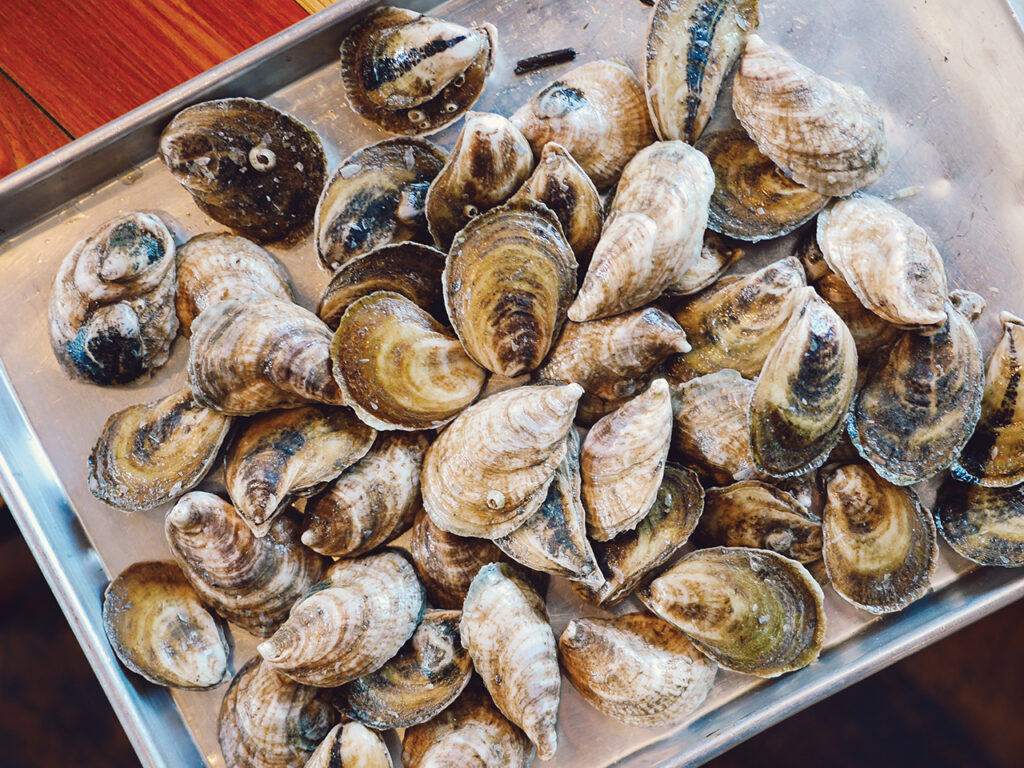
The restaruant’s oyster farm, Savannah Oyster Co., had its first harvest in October and aims to harvest between 8,000 and 10,000 oysters per week
Written by NICOLE LETTS
Photography by ZACH KOZDRON // Courtesy SAVANNAH OYSTER CO.
WHEN GEORGIA AMENDED STATE LAW in 2019 to allow oyster farming — a common method that uses cages for developing, growing and harvesting oysters — Harley Krinsky, managing owner of Savannah’s Sorry Charlie’s, wanted in on this new chapter of coastal Georgia maritime history.
With a few partners, including oysterman Nick Aliotta, Krinsky established Savannah Oyster Co. “There were six leases given out, and there are [currently] two active leases in Chatham County. We [along with Tybee Oyster Co.] are one of those two,” he explains. Sorry Charlie’s farm is at the mouth of Bull River where it meets Ossabaw Sound. Selected by the Georgia Department of Natural Resources for the leases, the water here, where fresh and saltwater come together, is highly salient, creating a briny, salty and ultimately delicious oyster.
Raising oysters is an around-the-clock job that combines marine biology and fishing skills with a pinch of mad scientist mentality. Oyster farmers are on the water daily, constantly cultivating, sorting, tumbling and flipping in hopes of yielding an ideal specimen. “We’re looking for a three-inch-deep cup, high salinity, briny, flavorful oyster. That’s our goal,” says Krinsky.

“We always had house oysters before, but they weren’t ours in the same way that these will be.”
— Rob Knarr, Sorry Charlie’s general manager
A veteran in the restaurant industry who has survived his fair share of ups and downs, Krinsky says this oyster adventure is among his most challenging yet. He’s among just a few pioneers for Georgia farm-raised oysters. “It’s definitely unlike any project that I’ve ever done before. There are so many other factors at play: wind, weather, tide and Mother Nature; we’re up against them all. Every day it’s been a new obstacle,” he says.
Take, for example, Hurricane Helene. It blasted Savannah with heavy winds, causing widespread power outages, school closures and downed trees. Fortunately, Savannah Oyster Co. and its employees weathered the storm, experiencing only a week’s delay in their launch. “There’s no guidebook; we are out there figuring it out and paving the way.”
Savannah Oyster Co. has been working with the UGA Marine Extension and Georgia Sea Grant, and Krinsky credits the school for their guidance and involvement. “They have been tasked to help make sure that we succeed, and we could never have accomplished this without them. They know the product in a way that we do not,” he explains. He also credits his oyster farming peers Perry and Laura Solomon of Tybee Oyster Co. “They’ve been awesome. They’re a little ahead of us, so being able to be near somebody who’s going through the same experiences that we are has been tremendous.”
Krinsky hopes that the oyster industry can fully return to Georgia and thrive. “We have enough waterways and enough opportunity that there’s no reason Georgia shouldn’t be known as an oyster farming capital. We have a great growing season because of our water temperatures. We’ve got great quality water; we’ve got high salinity. There’s a ton of great factors that would allow us to be successful,” he says.
The Sorry Charlie’s proprietary oyster, which had its first harvest in October, is named the Bull River in honor of its origin, and Savannah Oyster Co. has plans to market it both to local consumers and those beyond the Hostess City. Rob Knarr, general manager at Sorry Charlie’s says he’s excited about the possibilities: “We’ve talked about having an oyster topping kit using our hot sauce and developing a mignonette, too. I’ve been talking about it with our front-of-house staff for months. We always had house oysters before, but they weren’t ours in the same way that these will be.”
The goal for Savannah Oyster Co. is to harvest between 8,000 and 10,000 oysters per week — with plans to sell them at Sorry Charlie’s and beyond. This first harvest year is only the beginning.


