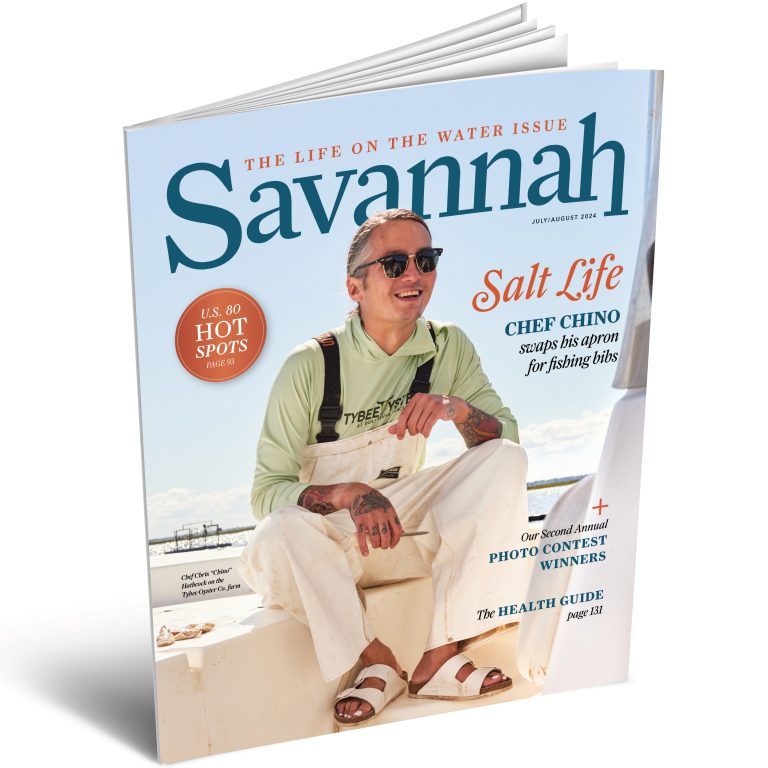



In between his buzzy pop-ups and rotating residency at Fleeting, chef Chris “Chino” Hathcock swaps his apron for fishing bibs while working on Bull River’s leading oyster farm
Written by COLLEEN ANN MCNALLY
Photography by MICHAEL SCHALK
AFTER WORKING AT SOME of the Southeast’s most acclaimed restaurants, including The National in Athens, Georgia, Staplehouse in Atlanta and, most recently, a six-year stint at Husk Savannah, chef Chris “Chino” Hathcock (also known as @chino_noir on Instagram) left his full-time position behind in pursuit of a more flexible schedule.
In the years since, he has launched new original concepts, including Odd Gai, a pop-up series drawing on Hathcock’s travels through Thailand and Southeast Asia, and Shinpaku, an izakaya residency at The Thompson Savannah’s Fleeting restaurant. Wherever he goes, a crowd follows — hungry to see what he is cooking up next. (Hint: it’s Mexican seafood).


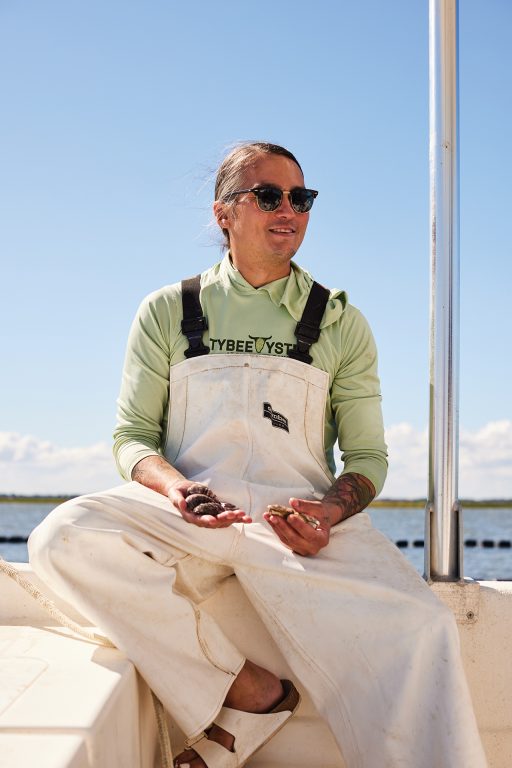
The recent change of pace is also allowing the Georgia native to explore another passion: oyster farming. Before excelling in the culinary arts, Hathcock received his bachelor’s degree in forestry and natural resources at the University of Georgia. When he is not traveling or in the kitchen, odds are he is lending a hand to oyster farmers Perry and Laura Solomon at the Tybee Oyster Company farm on Bull River.
Here, the the coastal cowboy shares where he finds inspiration, what he loves about living on the coast and where to find his food this summer.
ON HIS NICKNAME-TURNED-INSTAGRAM HANDLE
I go by both Chris and Chino. I always introduce myself as Chris, but anyone who gets to know me calls me Chino. It’s a nickname I’ve had for over 20 years. Working in restaurants as a teenager, I worked with a predominately Hispanic group, and they call anyone of Asian descent a chino. They would always say, “Chino, Chino,” when they wanted something from me since I was the only non-Hispanic person in the kitchen. When I moved on to other kitchens, there were always two or more people named Chris — it was such a popular name in the ’80s — so Chino stuck.
ON SAVANNAH’S EVOLVING FOOD SCENE
I came back in 2017 and there was no Starland Yard, no Fleeting, no Common Thread, no Late Air. None of that. Even in these past five years, the city has changed tremendously. It’s really good — it’s an attractive market. If you think of Charleston as a sister city, we are really similar to that. We’re just maybe a decade or 15 years behind, but the appreciation for raw ingredients is there. Savannah has become a major food corridor, for sure.
[Although] it’s not changing too fast, for me, it’s definitely getting saturated. Any chef in Savannah would tell you that it’s very hard to staff the restaurant when you have new places opening up every three months. People jump ship for greener pastures. … Post-COVID, mindsets changed. Many people used to glorify the grind and work these 60- or 70-plus-hour weeks. Having that time off really helped many people see things in a new light and realize that there are more important things in life than grinding and working.
ON PIVOTING TO POP-UPS
I worked in professional kitchens for 20 years. It was a lot, and burnout is real. I wanted to do things that aligned with my interests, work for myself and not be in the restaurant 60 or 70 hours a week and five nights until midnight. A lot of it is about having a more balanced life, mental health and trying to have more time for the things that matter in life, like my partner and my dog.
I’ve been doing these pop-ups because it’s a way to still be creative and a craftsman without having to deal with all the daily stuff that being a chef requires — labor, food costs and all the other nuances of having a huge staff. … The pop-ups are all for fun and to scratch an itch. I’ve got a very small group of folks helping me creatively and cooking with me, and it has been rewarding. I don’t want to do anything to mess that up. As long as it’s equitable for me and my people, as well as the host restaurant, that’s what matters to me.
It’s still tough. You’re creating a restaurant and moving into and out of someone’s space every week. You want to make sure you are treating that space with respect while executing at a high level, so it’s not just doing something all willy-nilly, having fun and dipping out. A lot of thought and energy goes into the pop-ups and residencies.


ON CREATING ORIGINAL CONCEPTS
Odd Gai was born out of Strange Bird. The name is a play on gai — meaning chicken in Thai — so we wanted to do Southeast Asian/Northern Thai/Lao food inspired by my heritage and travels through Thailand. We built in some Vietnamese food, too, so it really became a catchall for Southeast Asian food — and that’s the way I like to cook. Bright, bold, spicy flavors. Lots of acid, not a lot of fat and butter and gluten and heavy things.
When we did Shinpaku, it was more Japanese, with subtle, nuanced flavors and izakaya small plates. I wanted it to be just as much about the saki and soju as the fresh seafood and the food.
ON BECOMING AN OYSTERMAN
I’ve always been interested in oysters. I’ve always had a toe in the water — literally and figuratively — supporting Southern oysters and shell recycling programs like Shell to Shore out of Athens. I reached out to Perry and Laura Solomon over a year and a half ago to ask if I could check out the Tybee Oyster Company farm and give them some free labor — kind of like when chefs stage at a professional kitchen, which is like an unpaid trial to learn. That’s what I did.
Now that they are growing and we’ve built a relationship, we sat down and talked about me coming on board. As it is now, I am their only employee. It’s great because I grew up in and around Savannah, specifically on Tybee and Wilmington. It’s very rewarding to see this oyster from seed to market product and know the waters it came from and the care that went into it.
Perry and Laura are really involved with the community, environmental education and being stewards of the water. I can’t say enough good things about them. … There are really no downsides to oyster farming. It’s great for regenerating the coastline and habitat and filtering water and everything. That’s why I’m really all in on it.

ON HIS FAVORITE WAY TO EAT OYSTERS
On the boat after we pull them out of the water. I like them as they are: natural.
After a few days, the salt punch starts to slowly dissipate and it gets sweeter from the abductor muscle. They really do change every day. If I’m putting anything on them, I’m only adding acid — fresh lime or lemon juice.
I wouldn’t want to do any disservice by cooking them and having cocktail sauce and saltines. The oysters you do that with are the ones you get from Oyster Creek when you truck through the mud, pull them out during harvest season, wash them and have an oyster roast.
The Tybee Oyster “Salt Bombs” — as we call them — however are very special. They are handpicked from oyster baskets on the farm. You want to treat them like any other heirloom product — with respect and utilize them to the best of their ability. Eat them as minimally touched or processed as possible.
ON GIVING BACK
Giving Kitchen [a nonprofit that provides emergency assistance for food service workers through financial support and a network of community resources] is very close to me because I worked at Staplehouse, the restaurant associated with the nonprofit, for years.
The late chef Ryan Hidinger was a friend of all of ours and the reason Giving Kitchen got started. Every year, they do Team Hidi, a fundraiser with live auction lots to generate funds to help service workers in crisis. One of the lots is an experience on Ossabaw Island with chefs and winemakers. I’ve been a part of that lot for the past five years, so I’ve had the luxury of getting out to Ossabaw six or seven times now. It’s just an untouched heritage preserve. You can only go out there if it’s for educational, scientific or cultural purposes. It’s super special.
On our last trip, we saw hogs, alligators, blue herons, armadillos and all these species. It’s a magical place, truly. Bioluminescence right off the dock. It’s a huge barrier island that is uninhabited. Anyone can go there to the beach — it’s for public use — but you have to have a special permit to be on the island to explore.

ON WHY HE LOVES COASTAL LIVING
It’s what the bumper stickers say: island time. It’s the salt life. The slower pace. … I’m a Pisces, so I like to be on water, in water, near water. I’ve lived in the mountains, and I’ve lived in the city, and they all have their benefits, but Savannah is home for me.
ON WHAT’S NEXT
I am doing an extended residency in the Fleeting kitchen at The Thompson Savannah. Our plan is a month-on, month-off situation for a year, with each one focusing on a different cuisine. I’m going to revisit Odd Gai and Shinpaku but also do some new concepts. Starting July 1, on Mondays and Tuesdays, we will be running a concept called “Crybaby Mariscos” or “Crybaby” for short. It’s Mexican seafood, which ultimately is what I’ll be doing for a brick and mortar. Think aqua chiles, tostadas, ceviches — getting all the seafood from local waterways and showcasing them with Mexican flavors — and a tequila and mezcal program.
I’ve been doing wine dinners with Sobremesa here and there and will keep doing other pop-ups when they make sense. … I’m proud that I’m doing what I love now. Not that I didn’t love what I was doing before, but a lot of people get sucked into the lifestyle of being a chef. It’s nice to step back, put the ego aside and do something more rewarding versus being a badass chef, stroking the ego and chasing accolades. I find that I have a much more rewarding line of work now.