




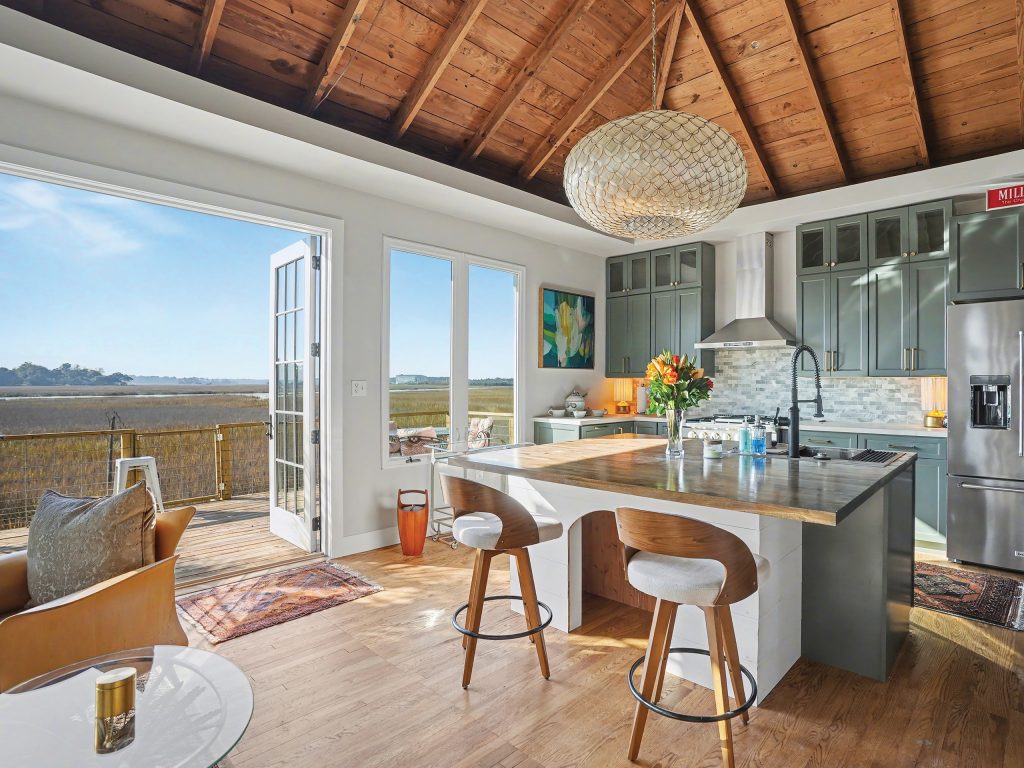
Abandoned for decades, this rustic property has been turned into a welcoming retreat with sweeping saltmarsh views.
Written by Kathryn Drury Wagner
Photography by Andrew Frazier
The remnants of the wooden dock, he says, is called “a ghost.” Paul Miller surveys the panoramic view before us: cordgrass, Grays Creek, sky. Pale fragments of weathered wood — dotted through the marsh like a path to nowhere — are the only clues that a dock was once here. But Miller is good at seeing the potential in things that are almost invisible.
Miller is the owner, contractor, and salvation for this property, which he calls the Shrimp Camp.
I’ve driven by this home on U.S. 80 at least twice a day for nearly a decade, but it wasn’t until about three years ago, when Miller began his work, that it started to reveal itself to us passersby.
Originally from International Falls, Minnesota, Miller has a degree in civil engineering and has worked in the construction industry for decades. He is the founder of The Savard Co. in Savannah. “Concrete paid the bills,” he says, “but we’ve renovated powder rooms, we did Sixby, we did Lori Judge’s office on Abercorn. I’ve been fortunate to have had really interesting projects walk through the door.”
The property came to his attention in November 2023 via his friend, real estate pro Lori Judge of Judge Realty. “Once in a while she’ll call and say, ‘I have a Paul Miller special,’” he jokes. “You know, kind of an shithole.”
When he arrived to tour the property, it was densely covered with vegetation. “You couldn’t even see the house,” Miller says. “You could barely make it up the driveway. It had been left alone for so long.” In fact, no one had lived in the home since 1979. There was no running water, no plumbing, and the floor was rotted out. “It was an absolute mess,” he says. Naturally, he was in.
“I enjoy the projects no one else wants to touch,” he says. “Seeing hidden beauty and then revealing it seems to be my talent.” It is also, he adds, his curse.
Miller says the home was originally built in 1925 for a dentist who wanted a rustic retreat. A subsequent owner envisioned a retirement spent on the water; he bought a shrimp boat for fun, despite having no experience in the field. The boat was at the end of that wooden dock on Grays Creek when it was sunk by a hurricane a mere three months later. So much for shrimping.
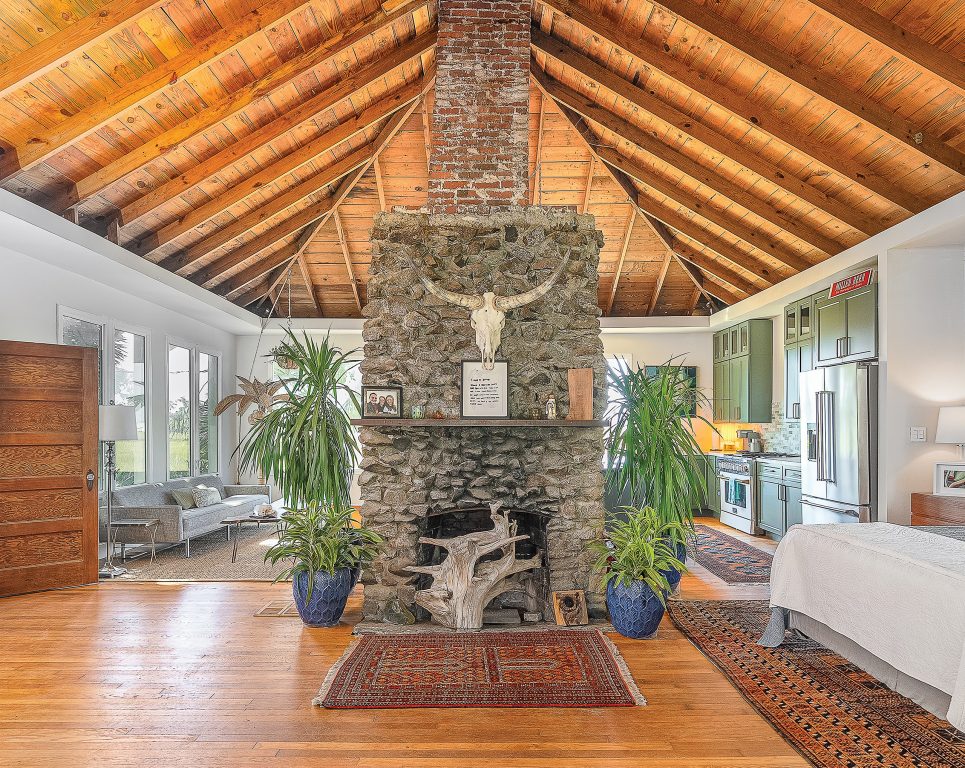
While it feels airy and spacious today, the home’s layout was originally cramped, with a living room, three bedrooms, a tiny hallway, and a small bathroom all packed in. A drop ceiling didn’t help; it was so low, you could reach up and touch it, Miller says. Once he removed that, the high angles of the pine ceiling were revealed, now aged to a golden color.
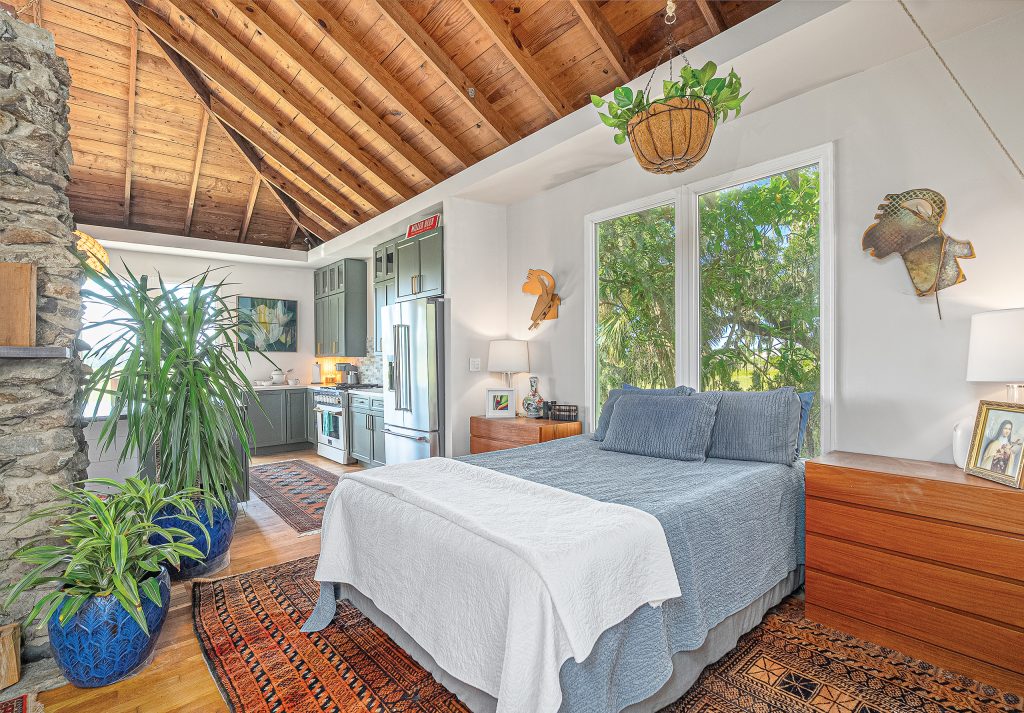
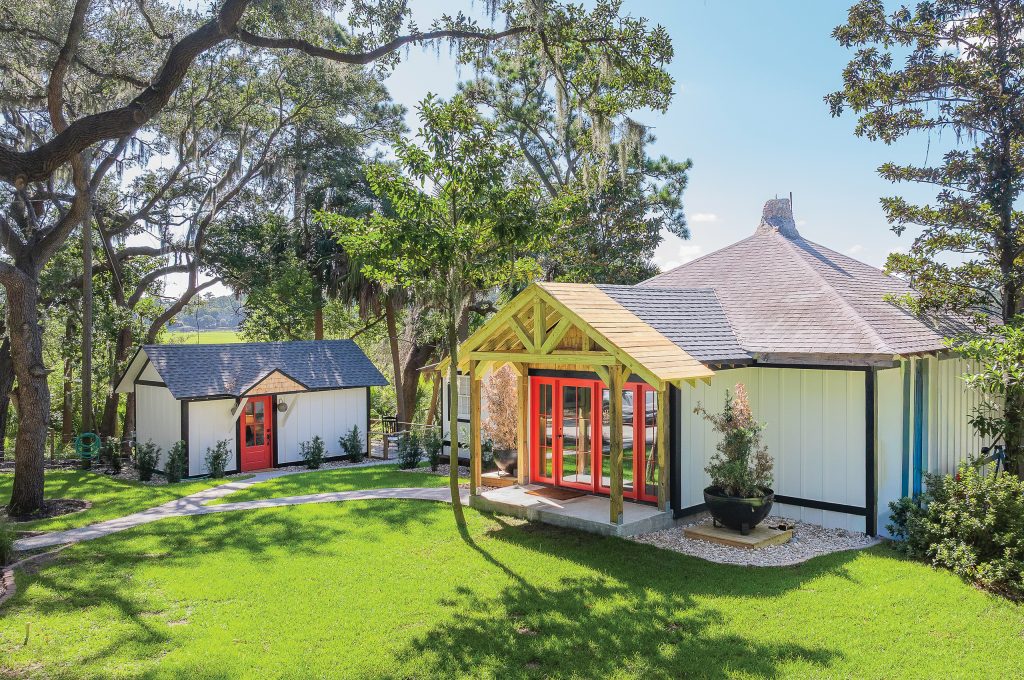
Miller converted one bedroom into a proper bathroom and removed walls from the rest of the home to create an open space. It now includes a spot for a large bed and two nightstands, along with an ample kitchen and a living room area. He moved the front door and added a welcoming front vestibule.
When you set foot in the house, the first thing you see is a ballast-stone chimney. It’s Miller’s favorite feature, with a “witch’s crook,” where the chimney changes direction abruptly toward the top. Back when the home was built (and for centuries before that), masons sometimes constructed chimneys this way to align them with the peak of the roof. But folklore, which is far more fun, tells us that a witch can’t fly down a crooked chimney, making the unusual architectural detail a protection from evil.
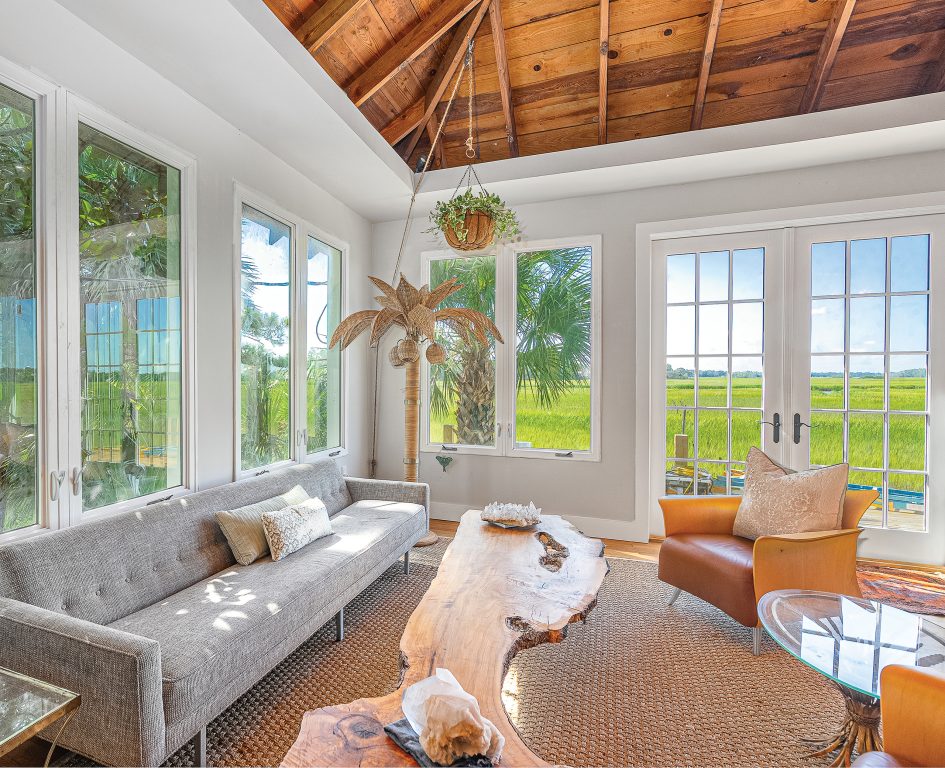
Much of the furniture is midcentury modern, with many pieces sourced from Picker Joe’s Antique Mall and Vintage Market. Despite hailing from a different era than the home, the warm wood tones and simple lines of the midcentury designs fit in seamlessly here, keeping the focus on the panoramic views of the marsh. The desk is by famed Danish designer Nanna Ditzel. “It’s practically a museum piece,” Miller explains. “She was one of the first female midcentury designers to make it big.”
Much of his art was sourced from Susan Laney at Laney Contemporary, such as the Katherine Sandoz paintings. The sculptures flanking the bed include “September,” as well as a study for the final work, by Curtis Patterson. “He’s done civil rights monuments in most of the major cities in this country,” says Miller. “He has some really important things to say.” Over time, he’s forged a friendship with Patterson, who is based in Atlanta. “I pick up barbecue and banana pudding and visit him in his studio,” says Miller.
Another good friend, Elizabeth Seeger, owner and founder of local handbag company Satchel, was responsible for the kitchen design. “She hit it spot on,” says Miller. It features semi-custom cabinets from Lowe’s and high-end appliances. “I’ve used a version of this refrigerator in five or six houses,” he says of the Frigidaire Professional Series. He proudly opens it up to show the walnut trim on the inside.
The renovation has taken time. “My work takes me all over, and because of that, the process has been sporadic at best,” he says. “I do not work with a plan, formal design, or drawings. Because I build primarily for myself, the design tends to be organic. For instance, very early on, I was wandering about the architectural scratch and dent section at Guerry Lumber. There were six huge windows that had been rejected on another home build. Needing windows for the camp, I purchased all six. As soon as you walk into my home, it is obvious I was the benefactor of the turn of a friendly card.”
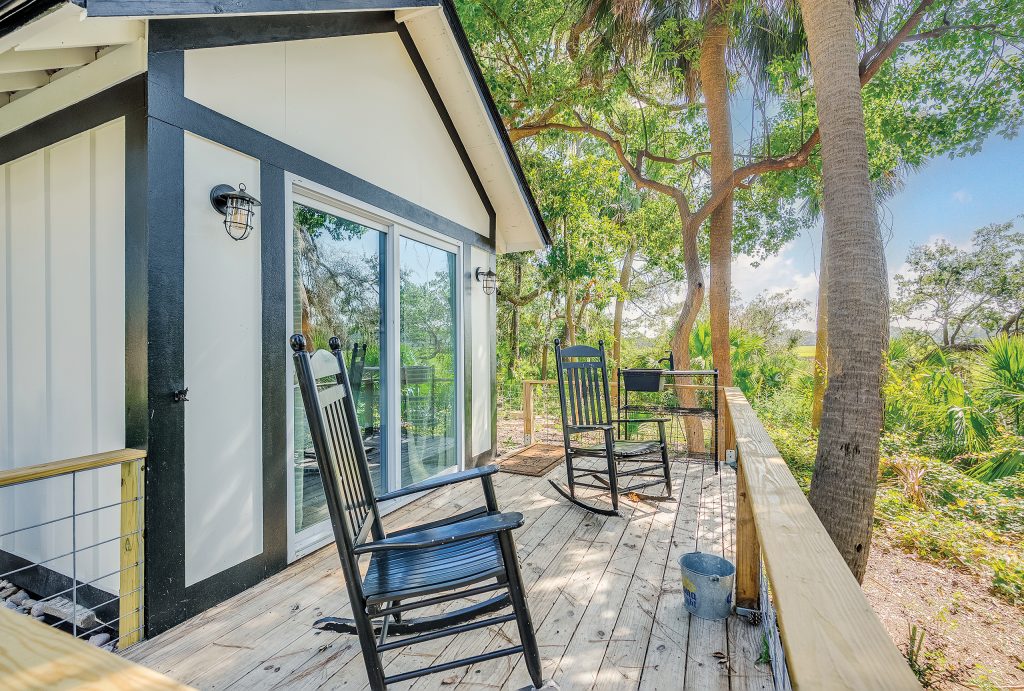
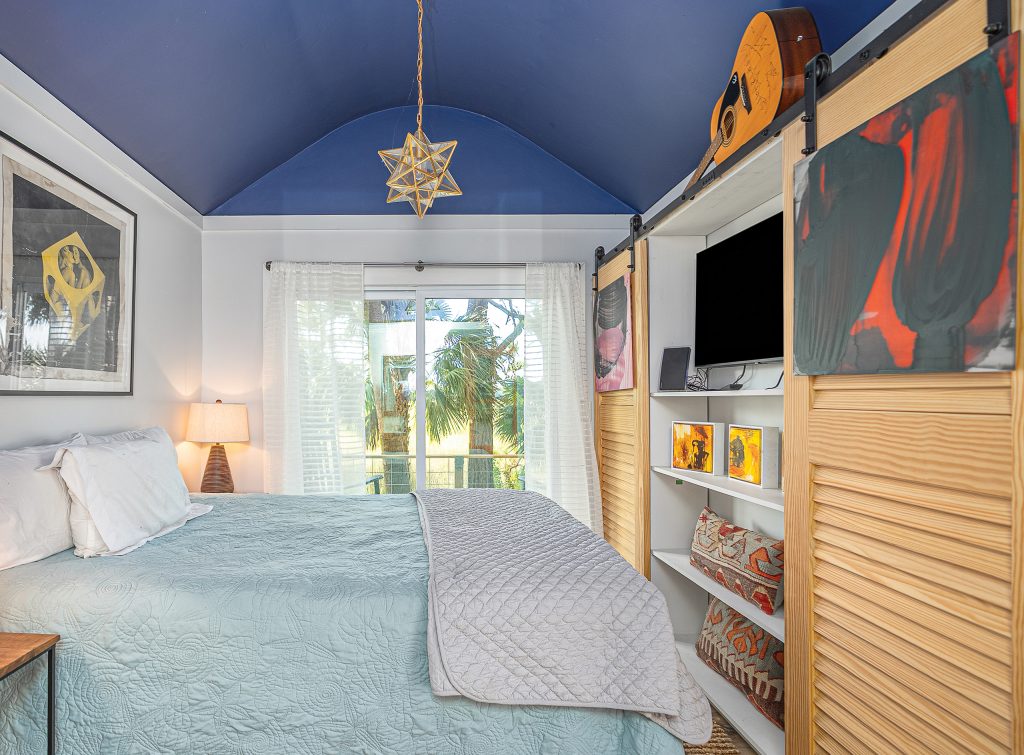
Next to the main house, a smaller structure was a lawnmower shed when Miller bought the property. He transformed it into a suite, with a bedroom, bathroom, and private deck.
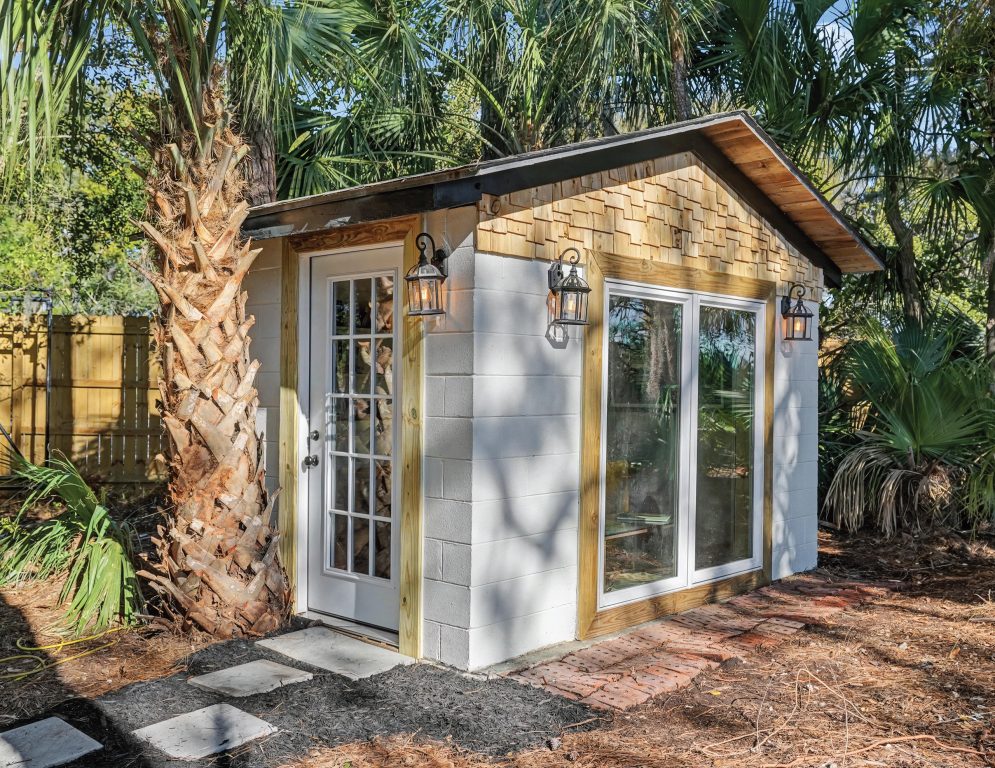
The parcel of land also has a third building, a concrete-block shed. It originally had been a bait shack, says Miller, selling wares to people coming along Route 80, and remnants of tanks for the bait remained behind it. The structure was so completely grown over, Miller didn’t even know it was there for several months after buying the property.
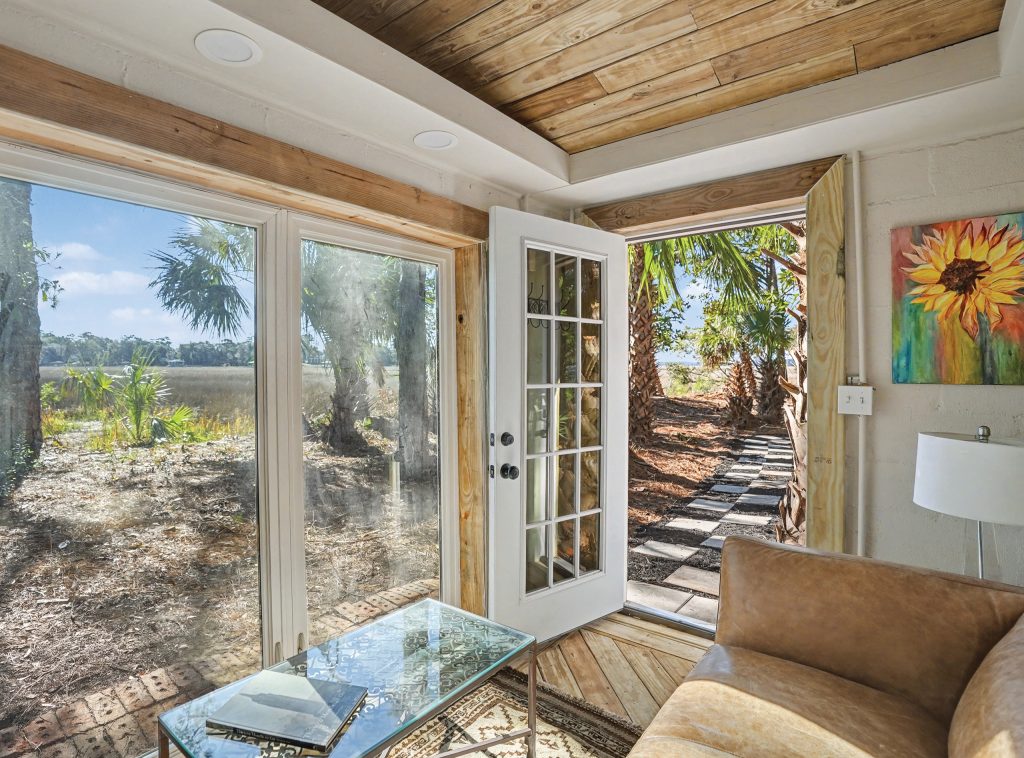
Clearing the vegetation from around the bait shack involved filling two dumpsters, but it was worth it. It’s now a cozy reading room or additional bedroom with a huge window facing the marsh and modern comforts such as power and HVAC.
It’s the perfect encapsulation of the Shrimp Camp — a place once abandoned and now uncovered and transformed to be enjoyed once again.
DETAILS
- Neighborhood: Thunderbolt
- Year built: 1925
- Year purchased: 2023
- Timeline of renovation/construction: 3 years
- Number of bedrooms: 2
- Number of bathrooms: 2
- Square footage: 1,208
- Builder/contractor: Paul Miller working with The Savard Co.
- Tree removal and landscape grooming: Herrington Tree Service
- Hardscape design: Paul Miller
- Septic tank: Olde Savannah Septic Services
- Kitchen design: Elizabeth Seeger
- Kitchen appliances: The stove is a dual-fuel Kucht with a griddle; refrigerator is a Frigidaire Professional Series; dishwasher is Bosch. Sourced from Livingood’s Appliances and Bedding.
- Kitchen cabinets: Semi-custom from Lowe’s
- Kitchen island: Walsh Custom Surfaces is creating a black marble topper
- Furniture: Mostly vintage midcentury modern, much of it from Picker Joe’s Antique Mall and Vintage Market
- Rugs: Vintage, sourced from Jacksonville
- Lighting: Serena & Lily in Bluffton
- Accessories: Handmade oyster-themed soup tureen and bowls from juried show at the New Orleans Jazz and Heritage Festival
- Windows/doors: Guerry Lumber
- Art: Most sourced from Laney Contemporary. Highlighted artists include painter Katherine Sandoz, photographer Jack Leigh, and sculptor Curtis Patterson