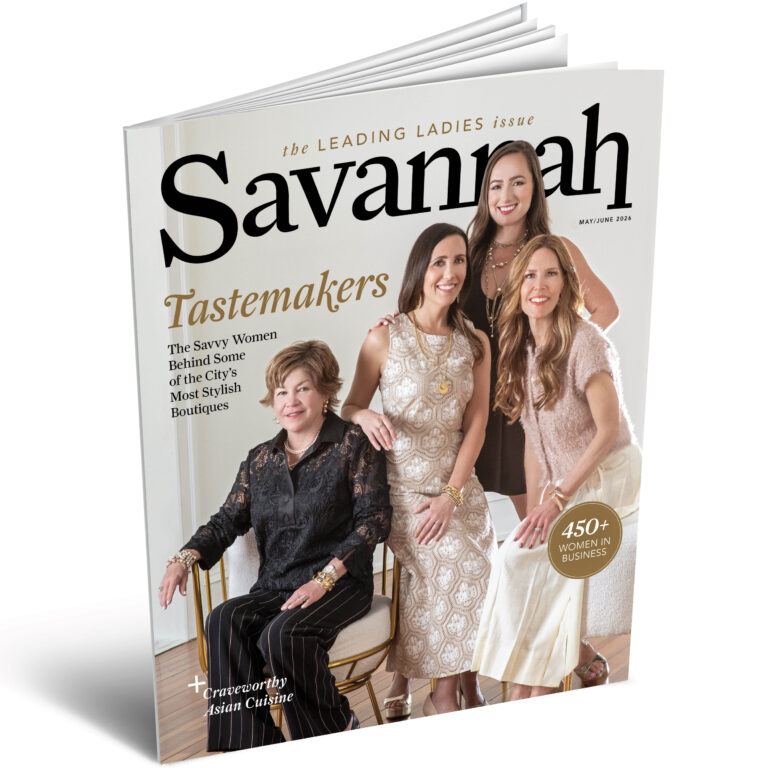

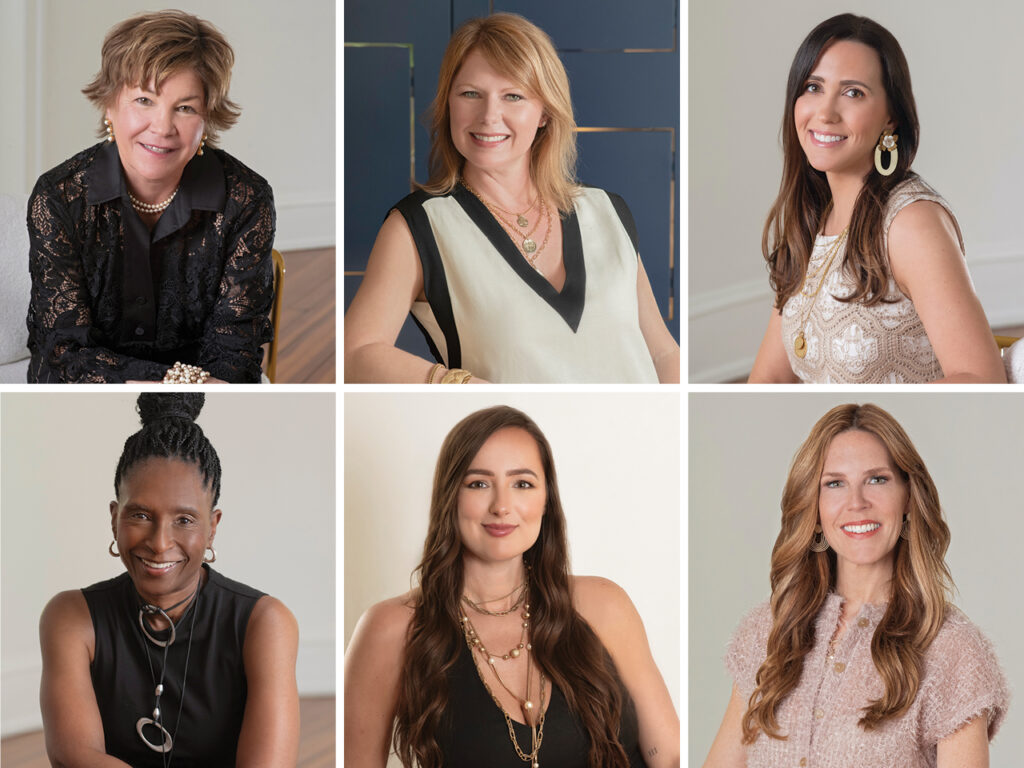
We celebrate the tastemakers behind some of the city’s favorite shopping destinations.
Written by Mary Cornetta, Paula Magrini, Kathryn Drury Wagner and Walinda P. West
Photography by Claire Barrett
Styling by Layne Brightwell
Hair & Makeup by Dawn Angeletti and Jadajah Martin
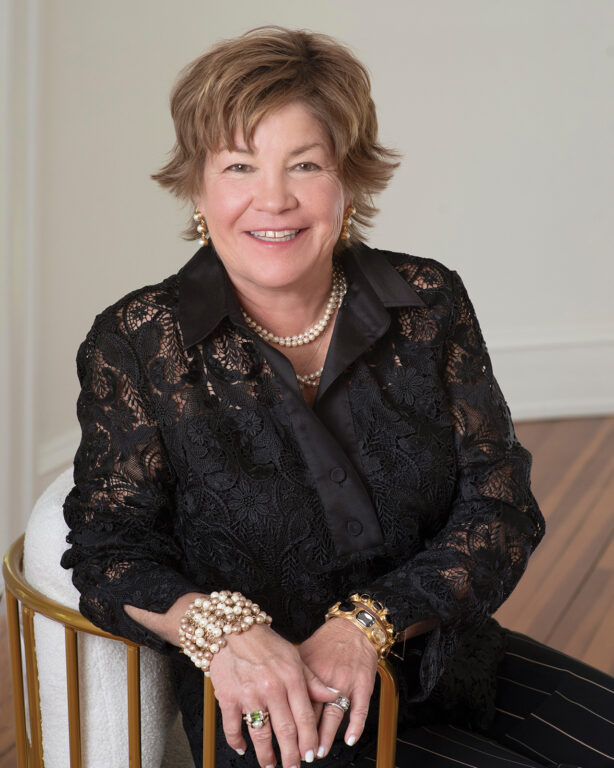
Dale Parker – J. Parker LTD.
As the girls’ basketball coach for Savannah Country Day School, Dale Parker led the team to 16 state playoffs and a state championship. She retired from teaching and coaching in 2015.
But she didn’t like to sit still, and she started going into the Broughton location of J. Parker LTD. a few days a week to work. Next thing she knew, she was working there full time.
J. Parker was started in 1972 by Parker’s husband, Jimmy, in the Medical Arts Shopping Center. That location, says Parker, is where the company’s tradition of serving local customers and building an experience for them began. “We’ve now served generations of families,” she says, “where the grandfather shopped with us, and then the son, and now he’s a father and is bringing his son in for his first suit, and we feel like, ‘Wow, we really are part of the community.’”
In 2005, the business moved to Broughton Street. In 2018, it added a location in Twelve Oaks Shopping Center and then continued to expand, with shops at Plant Riverside; Bluffton, South Carolina (its first location in the Lowcountry); and then J. Parker Ladies (its first location dedicated to women’s clothing), which opened two years ago. The newest addition is a store dedicated to custom men’s clothing, also located in Twelve Oaks Shopping Center. About 80% of the business is men’s, reports Parker.
“People are dressing up again,” she observes. “We’re seeing a big upswing not just in custom but also in sport coats, suits, dress shirts, and dress trousers — more than ever before.”
J. Parker features classic and contemporary brands including Peter Millar, Smathers & Branson, Martin Dingman, Hickey Freeman, Barbour, Filson, and more.
She and Jimmy, who is retired, were both born and raised in Savannah. “Our No. 1 value is the relationships we develop with our customers,” she says. “And we treat our employees like family. Some of them have been with us for years.” The team ranges from about 25 to 30 employees, growing during the busy holiday season.
The women’s clothing side of the business continues to expand. “Women want things that fit properly and make them feel confident,” says Parker. “A lot of the clothing we carry is timeless, but women are also looking for something more fashion-forward. We buy for men’s twice a year, and when we buy for women, we buy eight times a year.” In-store events, such as mahjong, cocktail hours, and trunk shows, add to the fun and make shopping a social experience. Female customers also appreciate that the stores carry bags, jewelry, shoes, and hats, so they can get their whole outfit in one place, says Parker. She’s involved in everything from buying the merchandise to supporting employees.
Her background in basketball coaching has helped her tremendously as a business leader, she notes. “We had very successful teams, but if we hadn’t worked together, we wouldn’t have been successful,” Parker says. “It’s the same with retail.” — Written by Kathryn Drury Wagner
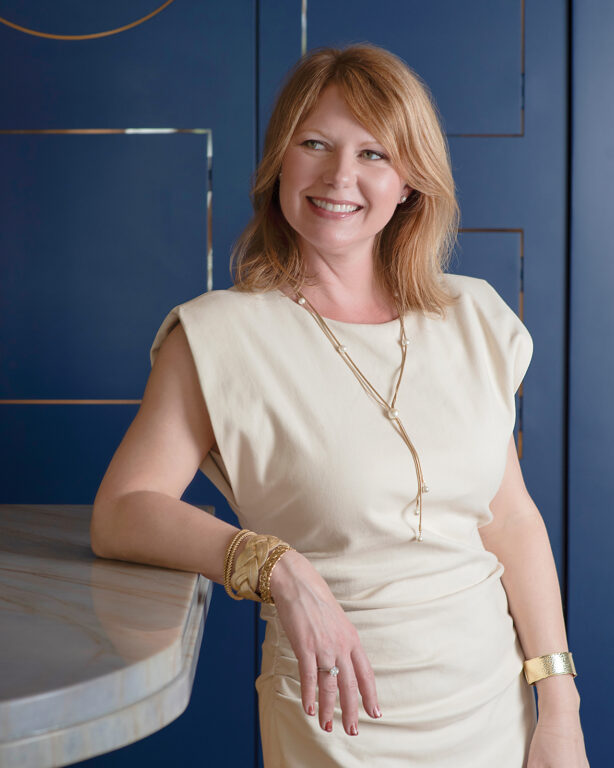
Elizabeth Seeger – Satchel
Hurricane Katrina caused the unexpected change of plan that led Satchel owner and founder Elizabeth Seeger back to Savannah, where she had received a degree in fashion design from the Savannah College of Art and Design in 2005. Originally from Covington, Louisiana, Seeger had gone to Los Angeles prepared to put her new degree to use. Yet she felt a strong pull to return to the South. The extensive destruction left in the wake of Katrina ruled out a return to her hometown, so she pivoted and opened Satchel on Broughton Street in 2006.
The thriving boutique is now celebrating its 20th anniversary. Seeger attributes her success to the collaborative, empathetic team she’s assembled. “We are a small team working in a close-knit environment, so it is essential that our personalities align well,” she explains. “We have intentionally cultivated a workplace culture that feels like family.”
The team consists of 13 employees across two locations. After the first decade in business, Seeger opened a space dedicated to the growing needs of the production team, about a mile from the storefront. “Broughton Street was our home for the first seven years before we relocated to Liberty Street,” Seeger notes. “We also operated a location at the Savannah/Hilton Head International Airport from 2019 to 2022.”
An intuitive business leader, Seeger grants her team a high level of autonomy. While she provides guidance and perspective when needed, she makes an effort to avoid micromanaging. By fostering flexibility and trust, Seeger believes she inspires growth and a stronger sense of ownership and investment in the business.
Satchel has become a fashion staple in Savannah thanks to Seeger’s approach and signature inventory. “What sets us apart is that all of our products are made locally in Savannah,” she says. “We also specialize in custom work, allowing clients to modify existing designs or collaborate with us to create something entirely new.”
Many of Satchel’s new styles originate from these custom projects and are often named after the clients who inspired them. “We have crafted unique pieces from sentimental materials, including a leather jacket, military uniforms, bridal lace, and more, ranging from handbags to knife rolls, gun cases, and guitar straps,” Seeger says.
She adds that Satchel may appear to focus on handbags from the outside. In reality, the range of what her team can create is extensive.
What are the trends among Savannah shoppers? Smaller shoulder bags are especially popular, according to Seeger. “Our sling style, the Solene, continues to sell out quickly,” she says. The newest design, the Tulip Tote, has received an enthusiastic response, she adds.
Seeger says she’s placing an emphasis on new designs, including fresh options in leathers and fabrics. “We will be unveiling a collection of beach bags for the summer and experimenting with a line of aprons and coordinating kitchen items,” she says. Quick to leverage the buzz around a popular coastal pastime, Satchel is also introducing mahjong bags in colorful prints. As always, the brand is aligned with the pulse of Savannah lifestyles. — Written by Paula Magrini
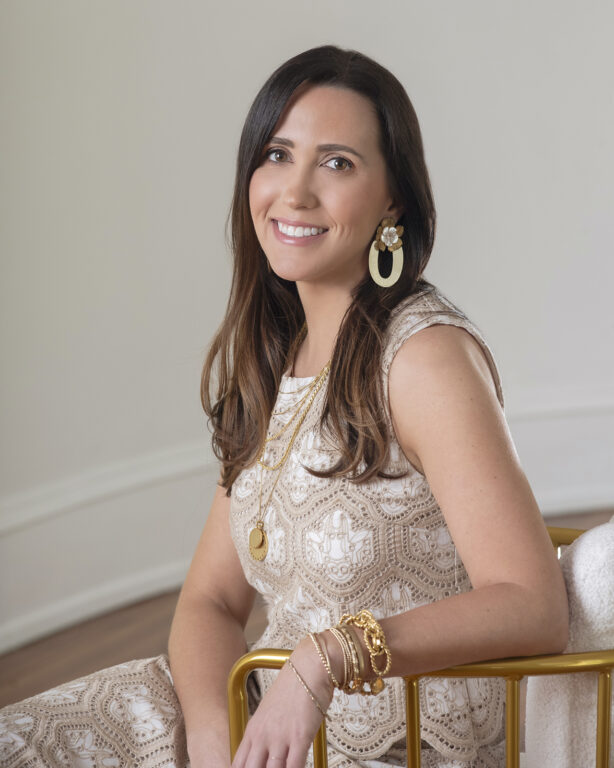
Margaret Stanley – Midge
When she named her Broughton Street boutique “Midge,” Margaret Stanley did not anticipate the response. “I did not expect to be a Barbie historian every day,” she laughs. “I just wanted the store to have a cool name with a meaning behind it.”
But customers can’t help but chat about Midge, originally marketed by Mattel as Barbie’s more wholesome bestie. (And fun fact: Midge’s “real name” is Margaret.)
Like many of us, Stanley grew up playing with Barbies. “We had our Barbies and my mom’s all mixed together,” she says. “The ones that had been my mom’s had higher quality clothes, with tiny zippers and designated outfits like ‘Sorority Meeting’ and ‘Garden Party.’ I loved it.”
From that early exposure to well-made fashions, Stanley went on to work at several shoe stores while attending college at Ole Miss, then worked her way up to being a store manager and buyer in Atlanta. There, she gained experience with clothing vendors and their representatives, and made lists of which lines she would one day carry in her own store. This year, she’s celebrating the 10th anniversary of that boutique, which exclusively carries made-in-America clothing for women.
“I pride myself on carrying the clothes that you’re going to live in,” says Stanley. “Your favorite pair of jeans, your favorite T-shirt.”
She focuses on U.S.-made clothing because the quality is better. “The softness of the fabrics, the dyes used. And from an ethical standpoint, the U.S. has higher standards on labor laws and working conditions,” Stanley says. “My dad did a lot of environmental work when I was growing up, so we were very into recycling. I’m not a minimalist, but I’m looking for clothing that is going to last. There’s so much waste out there.”
At Midge, you’ll find timeless, wearable clothing with an emphasis on neutrals. “When we first opened, I got a lot of comments about the amount of neutrals we carried, like ‘Oh, you need more color!’” says Stanley. “I will carry color. But for me, it’s about the piece. It has to be the right shade. I want it to be elevated and classic.”
Looking ahead, Stanley is considering doing a Midge capsule line, “like a great trouser, a classic trench, a core line of classic closet staples that people are looking for,” she says. She’s also considering adding a rack of vintage clothing to the store.
Her team consists of four part-timers. “I’ve been lucky with really amazing employees,” she says. “SCAD is a great resource because you have students who really care about clothes, who are majoring in fashion, who want to look at the construction of things. I want their opinions. When they start with me as freshman and then go through to graduation, I call them my inner circle,” Stanley says. “One of my originals, I talked to her a lot last year because she opened her own store in Charlotte. She was like ‘Can I pick your brain?’ and I said, ‘Absolutely!’ It was a full-circle moment for me.” — Written by Kathryn Drury Wagner
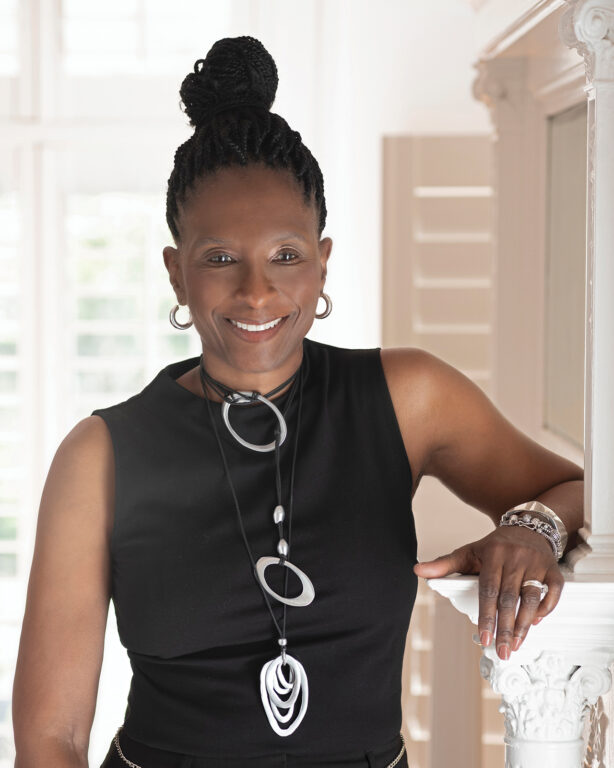
Dawn Anderson – Coastal Table and Tales
For more than two decades, Dawn Anderson moved through the world accompanying her diplomat husband across continents where meals were rarely just meals. In embassies and private homes, she hosted and was hosted, taking in not only flavors but the culture within them, how dishes are shared, how stories are told, how hospitality means something more. When that chapter ended, the question of what came next felt less like reinvention and more like a continuation of what she had always done. This past November, she opened Coastal Table and Tales on Bull Street.
“As part of a diplomatic life, I’ve had the opportunity to engage deeply with different cultures and cuisines,” Anderson says. “The shop is an extension of that, sharing what I’ve learned through those experiences.” Coastal Table and Tales occupies a space that is hard to categorize. It is, at once, a bookstore, a kitchen, and a cultural salon — an idea that would feel just as at home in Brooklyn, New York, or Paris as it does in Savannah. “We’re the only culinary bookstore in the state and region paired with a cooking workshop,” she says. “That combination allows people not just to read about food but to cook it, taste it, and understand the context behind it.”
The premise is straightforward: a tightly curated selection of cookbooks, hands-on classes, and conversations designed to entice people to stay awhile. But the intent, Anderson says, runs deeper. Cookbooks are treated not as objects on a shelf but as working texts that are handled, marked, tested. In workshops — recent offerings included “The Gullah Geechee Table: Cooking, Culture, and Tradition with Gina Willis” and “Chocolate, Understood with Kaysee Hill” — participants move beyond just preparation toward interpretation.
Anderson leads with attentiveness, listening to what people are cooking, what they feel is missing, what draws them back. Early signs of resonance are subtle but telling: guests who stay long after an event ends, conversations that stretch, repeat visits that feel less transactional than relational. “We’re building a business,” she says, “but we’re also building a community.”
The space itself reinforces that philosophy. Shelves are edited with precision, favoring depth over breadth; a Southern baking book might sit alongside a book on Asian cuisine or a memoir told through recipes. The artwork on the walls is pulled from Anderson’s personal collection, acquired during her travels, and the programming is kept small to ensure the “tales” don’t get lost in the “table.” If there is a defining idea, it is this: Food is a point of connection. Not everyone cooks, but almost everyone understands the language of gathering and of creating something together.
In an era of online recipes and fast-casual dining, Coastal Table and Tales is a sophisticated argument for being present. It isn’t just a place to buy a book; it’s a place to gain a worldview. — Written by Walinda P. West
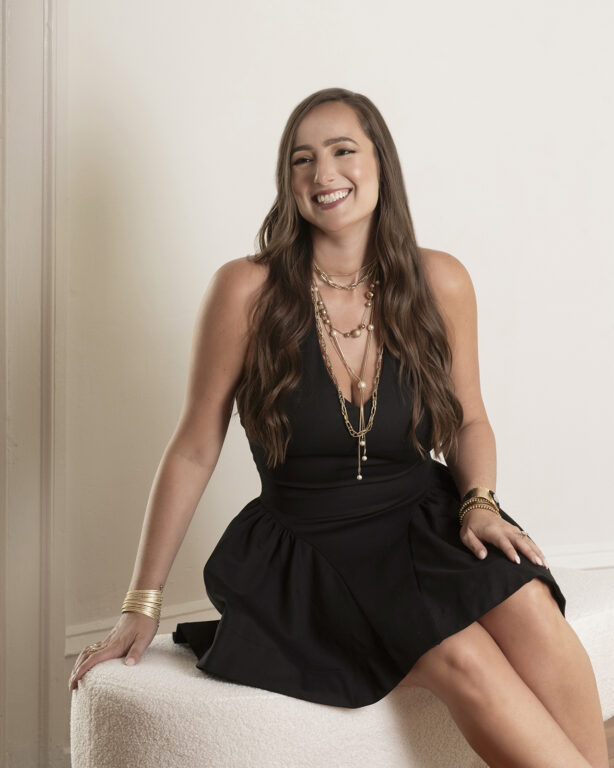
Morgan Hammock – Morgan Rae Boutique
When she first had the idea to open Morgan Rae Boutique, Morgan Hammock wanted to make it an experience, or “a space where women feel seen, confident, and taken care of,” as she describes it. Since opening the boutique in October 2019, that vision has come to life inside its second-story space at 301 W. Broughton St., where what began as a small dream has grown into a standout in Savannah’s shopping scene, thanks in large part to Hammock’s focus on relationships over transactions.
“We go beyond just selling clothing; we build real connections,” she says, noting that customers often return not just to add to their wardrobe, but for the feeling of fellowship. The boutique’s loyal following reflects that both in-store and online, where a consistently growing community (now more than 22,000 strong on Instagram alone) keeps up with new arrivals and style inspiration. Hammock explains that their thoughtfully curated inventory includes a little something for everyone — at any stage of life and for every occasion they may attend — from daily wear (like a summery linen set) to special-event pieces (such as a sequined midi dress).
That same sense of personalization extends beyond clothing at Morgan Rae Boutique. In late 2024, Hammock introduced the boutique’s Charm Bar, an interactive experience that invites customers to design custom necklaces, bracelets, bag chains, keychains, and brooches. The concept has quickly become a favorite around town, with pop-up Charm Bar events hosted at local spots like The Grove and The Lost Square (atop The Alida), as well as private bookings for bachelorette parties, girls’ nights out, or birthdays.
In a retail landscape increasingly dominated by e-commerce, Morgan Rae Boutique offers something special: a human experience. Hammock has found a balance between the convenience of online shopping (she has a website and launched an app for the business during COVID) and the connection of an in-store visit, with her genuine passion and attention to detail creating an atmosphere that simply can’t be reproduced by larger chain stores. She remains a strong advocate for shopping local. “It makes a real impact on the community and the women behind these businesses,” she says.
Aside from supporting her fellow business owners, Hammock also makes a point to pay it forward to those in need. “Giving back to our local community has always been a core priority and a true driving force behind everything we do,” she shares. Morgan Rae Boutique regularly donates to local school silent auctions and supports a range of Savannah sports teams, including her alma mater, St. Vincent’s Academy, through year-round sponsorships and contributions.
The boutique also partners with organizations like the Ronald McDonald House Charities of the Coastal Empire, the Alzheimer’s Association, and Shelter From the Rain. Each October, Hammock hosts an annual Ladies Night event benefiting single mothers in need, an initiative that has raised more than $20,000 to date. “I always encourage our team to volunteer together,” she adds. “It not only strengthens our bond but also reinforces the importance of giving back to the community that gives so much to us.”
Looking ahead, Hammock is excited about what’s to come. From seasonal arrivals to successful pop-up events (such as a recent one she held at Pendant Terrace and Bar at the Drayton Hotel), she’s focused on continuing to bring people together and help them look and feel their best while keeping up with Savannah as it grows and changes. At its core, the boutique remains rooted in the same mission it started with: connection, care, and making women feel self-assured.
Her advice to shoppers reflects that ethos. “Look for pieces that make you feel confident, comfortable, and truly yourself,” she says, because those are the ones you’ll keep reaching for long after you leave the store. — Written by Mary Cornetta
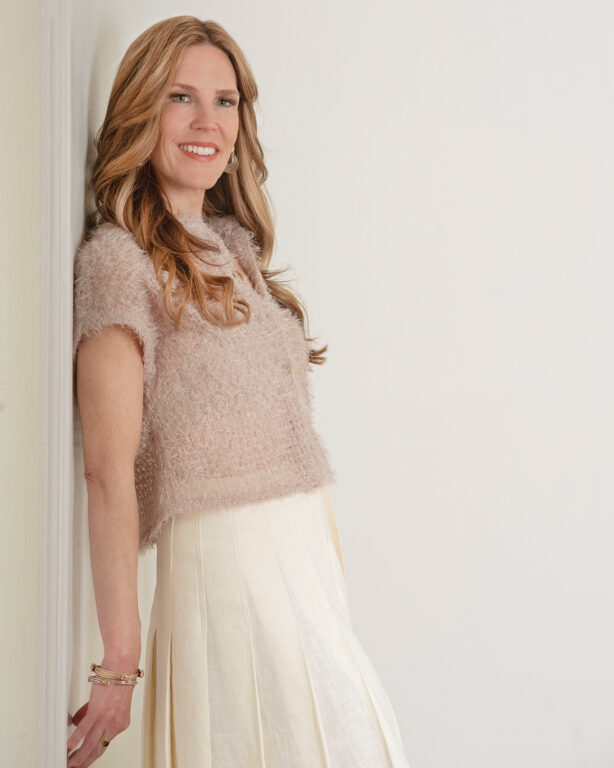
Erika Snayd – Asher + Rye
Erika Snayd, co-owner and managing partner of lifestyle brand Asher + Rye, just celebrated the fifth anniversary of the company’s brick-and-mortar location on Whitaker Street. The brand includes a full-service interior design studio, a shop with clothing, home goods, and accessories, and a cafe. “We’ve grown, but it still feels very personal,” Snayd says.
She describes the process at Asher + Rye as collaborative, noting she trusts her team and places a high value on considerate, intentional productivity. Working alongside her husband, Joel, Snayd shares in decision-making and stays focused on details and tone — the way everything comes together. She says Joel has his own focus, steering creative aspects of the business. They complement each other with a simpatico balance.
Currently, Asher + Rye has a team of 26. “We’ve made a conscious decision to reduce the number of part-time employees and offer full-time opportunities, which was a game changer,” says Snayd. It’s important to her that the company still feels like one unit.
The Asher + Rye shop offers pieces that are functional and well-made, but also thoughtful and enduring. The inventory includes items you use every day — the ones that age gracefully as they become a staple in your routine.
Snayd says the café came in as an extension of the same concept. “We wanted a place to experience the lifestyle we’re trying to create, not just shop it,” she says. “It’s never been just about retail for us. It’s always been about creating a place where people want to return, again and again.”
“The shop and café keeps us grounded in daily life, while the studio continues to take on full-service projects both locally and beyond,” says Snayd. “That sense of connectedness and intimacy is something we’re intentional about maintaining.”
Snayd’s philosophy on leadership? “I think that’s knowing when to step in and when to give space. Sometimes I get it right, sometimes I don’t,” she says.
She and Joel tap designers and makers they truly believe in, often sourcing from New York City and Europe, and keeping quantities limited so it still feels considered.
Among their treasured customers are the women of Savannah. Snayd notes they are discerning, and seek quality and longevity. If they’re investing in something, they want to know how it was made, how it will wear over time, and how it fits into their life. Individuality is important, too. “If it’s a dress for an event like the Telfair Ball, they don’t want to show up and see someone else wearing the same thing,” Snayd says. “There’s an appreciation for pieces that feel a little more considered, a little more unique.”
Customers come in knowing they can find something thoughtful, Snayd says, whether that’s clothing, accessories, or something for the home.“They’ll grab a coffee, walk the shop, and it becomes less of an errand and more of a moment.”
“In a lot of ways, it feels like we’re just getting started. After five years, everything feels more aligned,” says Snayd. “We have a clearer point of view, and the business is moving in a way that feels completely natural.” — Written by Paula Magrini