




Life-altering virtual reality therapies are bringing new hope to palliative-care patients and those who care for them.
Written by ANDREA GOTO
Photography by JOHN ALEXANDER
AIRMAN CHARLES “BUD” NOSIL was grounded at age 81. Prior to that, flying had been his life. He began when he was just 13 years old, and his career in the Civil Air Patrol (CAP) earned him over 60 years of experience, as well as a Wright Brothers Master Pilot Award — one of the most prestigious awards given by the Federal Aviation Administration.
“My life is pretty changed,” says the former airman, now 94, who has since been diagnosed with leukemia, is legally blind, and needs assistance to walk. But one thing remains: “I miss flying,” he says.
As we age, or experience serious illness and the resulting physical and cognitive decline, we often have to give up the things we love and learn to lean on others for care. The World Health Organization reports that 56.8 million people need palliative care each year, including 25.7 million during the end of life. (Palliative care focuses on improving quality of life during serious illness, while hospice care is specifically for those at the end of life.) This, coupled with the loss of autonomy that can come with aging, can cause depression, isolation, and anxiety. Locally, Hospice Savannah is turning toward innovative technologies to improve palliative care to tend to this growing population.
New Worlds and Past Experiences
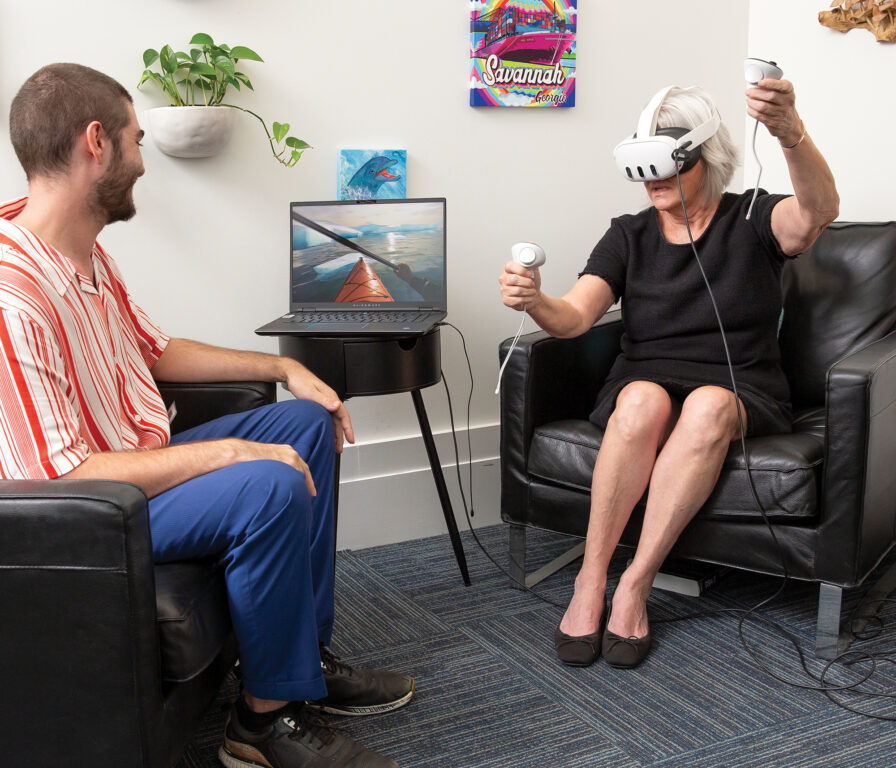
In 2018, a collaboration between Hospice Savannah and Savannah College of Art and Design (SCAD) began looking into ways virtual reality (VR) could improve the quality of life for patients in palliative care. It wasn’t a matter of if it could, but how it could. Even back then, VR therapy had been widely studied and was already being used in leading medical research institutions such as Johns Hopkins, Cedars-Sinai, and Mayo Clinic.
Kathleen Benton, president and CEO at Hospice Savannah (2025 Winner, Best Hospice Care Provier), had just been appointed to her position when she connected with VR specialist Teri Yarbrow, CEO of Magika VRx and a SCAD professor at the time. Together they launched VR for Good — a course where students would interview palliative patients to develop and test VR content, making Hospice Savannah one of the first hospice clinics in the nation to offer this therapy.
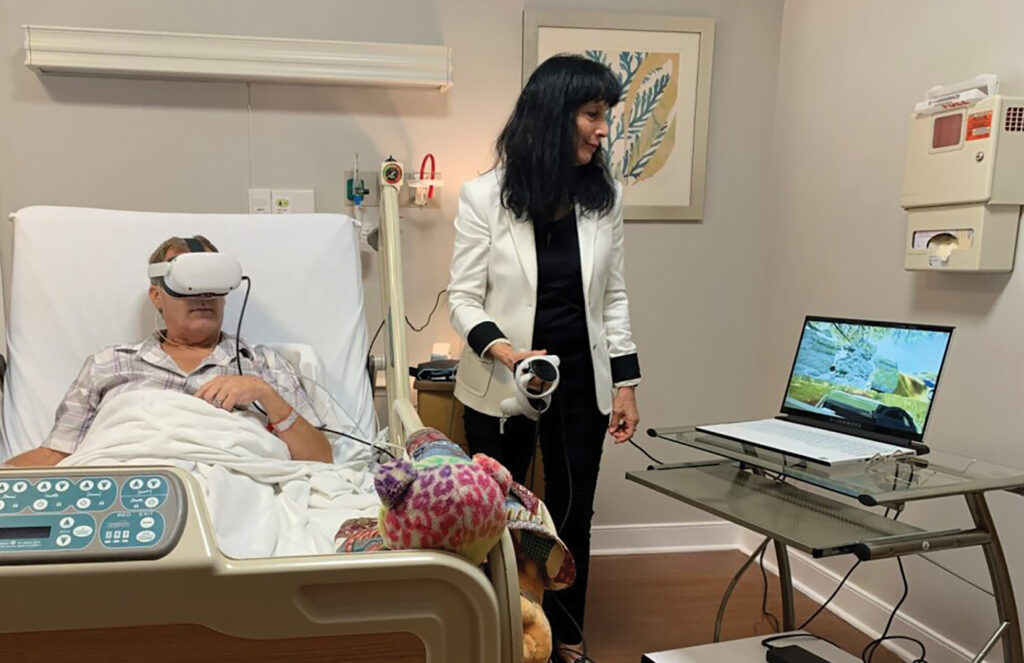
This is how Nosil came to fly again. In the care of Hospice Savannah, he was asked if he’d like to try a student-developed immersive flight simulation, and he didn’t hesitate.
“I put this virtual reality headset on and it put me in the cockpit of this airplane to do some acrobatics, and it felt like I was there,” he says. “Then they put me in the glass cockpit of a helicopter flying through the Amazon.” Nosil was not only thrilled to fly but also to see clearly. The headset, an Oculus, is able to magnify sight. “I just couldn’t put it down because it was just so fascinating to be able to see again. It was just such an awesome feeling.”
Lasting Relief
Benton explains that it takes the brain less than 30 seconds to believe that a VR simulation is real, allowing the user to feel physically present in a nonphysical world, and, as such, escape the confines of their current condition. There was already evidence that VR could “distract” people from anxiety and neuropathic pain, but Benton was curious about the long- and short-term effectiveness of virtual-reality therapy with palliative-care patients.
Benton, Yarbrow, and their team began a study in Savannah in 2021 that yielded positive results. Approximately 85% of participants reported an improvement in their pain level immediately after the VR experience; 62% experienced a 50% improvement in pain levels; and 23% experienced more than a 50% improvement. All of the participants said they benefitted from the VR therapy.
One participant, a 62-year-old woman who had become a quadriplegic from a car accident, had been experiencing severe neuropathic pain in her shoulders and arms. Not even prescribed pain medication could make her comfortable. After experiencing “Nalu, Heart of the Ocean,” an 11-minute immersive underwater experience where the viewer observes underwater sea life and sounds, the woman reported that she was pain-free not only during and immediately after the session, but up to eight hours later.
Finding Peace
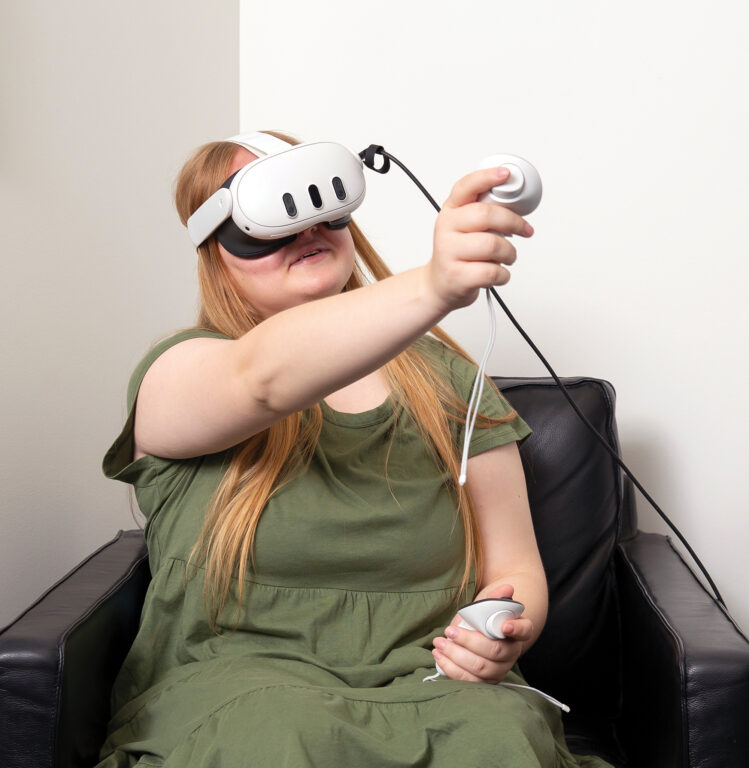
But the study revealed something even more groundbreaking. “Yes, it negated pain, but what we didn’t expect was that it helped these patients find spiritual healing, which is really important, especially in end-of-life care,” Benton says. “It doesn’t matter if you’re religious. We’re all spiritual because we look for meaning and purpose in life as a human being.”
She noticed that when patients experienced VR therapy, they could realize that they were part of something bigger. “It’s like the same thing you feel when you’re in nature or see a beautiful sunset; you feel insignificant in a positive way,” she explains. “Being just a small part of a big universe elicits a kind of healing, and that’s what these patients were experiencing.”
Benton recalls a 13-year-old boy in hospice care who used VR therapy on a daily basis. “He was held hostage by his disease, and he was able to just be a child in that immersive world,” she says. “He definitely found peace.” Benton believes this was based on how the boy’s focus shifted after he started therapy. Instead of fixating on his own pain, he became more concerned with how his family would eventually grieve. He even planned his own end-of-life party. “He got into purposeful, meaningful legacy work,” Benton says.
The Right Dose
Benton is quick to point out that VR therapy involves much more than just putting a headset on a patient and plugging in content. There are strict protocols and procedures to follow, which Yarbrow is helping to develop.
“You can’t just say, ‘VR works, let me get one of these for Christmas for someone,’” Benton says. “You have to have a trained facilitator, and that’s something Teri has dedicated her life to.” Yarbrow not only produces and supplies the content for hospices and allied care organizations, but she also implements a program for training staff and caregivers. Part of this training involves interviewing patients to curate the most useful VR experiences for them.
Healthcare providers also have to determine when VR is no longer an appropriate therapy. Maj. Robert McGinn, father of Terri Collins, vice-president of business development and strategy at Hospice Savannah, was a retired Army Ranger who had COPD and heart failure, was showing early signs of dementia, and eventually became bedridden. Over time, McGinn grew increasingly socially isolated and depressed, especially after the passing of his wife.
Collins asked the SCAD students if they could create a VR experience for her father. While he’d traveled all over the world, McGinn says he always regretted not being able to join his wife and daughter when they took a trip to Montana, and Collins wanted to give him that opportunity.
McGinn was reluctant at first to try VR, but Collins managed to convince him. She explained to him that while he couldn’t go on a plane to Montana, he could still experience the same beautiful things that she and her mother saw there.
“You have to build that level of trust,” Collins says. “It’s a new thing for that generation. They need to feel safe.”
McGinn experienced the simulated trip to Montana early in the program’s development, and his daughter said he was smiling the whole time. He was engaged, and she believes it gave him a sense of peace. But by the time the project was complete, McGinn’s dementia had worsened, and it was clear that the experience was agitating him, so they halted the therapy. (There has since been data collected to help determine when VR therapy is no longer appropriate for patients.) Still, Collins is grateful that her father got to see Montana before he passed away in 2019.
Leading the Charge
With new information comes new understanding, and Benton remains hopeful and inspired about the possibilities of implementing an even more comprehensive VR therapy program. To do this, she helped lobby to make Georgia the 33rd state in the nation plus the District of Columbia to adopt the Program of All-inclusive Care for the Elderly (PACE). Backed by Medicare/Medicaid, PACE aims to help seniors live independently for as long as possible by coordinating all necessary medical and social services. With the passing of the bill, Hospice Savannah is working toward becoming a PACE provider for the Chatham County area.
“We’re one of the most progressive hospice/palliative clinics in the U.S., and I am committed to bringing that same innovation to the PACE model,” says Benton. “By incorporating virtual reality therapy, we hope to address key challenges such as social isolation and loneliness among older adults, offering immersive experiences that promote emotional well-being and meaningful engagement.”
This commitment means more people like Nosil can find comfort and joy through virtual experiences, proving that even toward the end of life, there can still be much to gain and new ways to explore.