




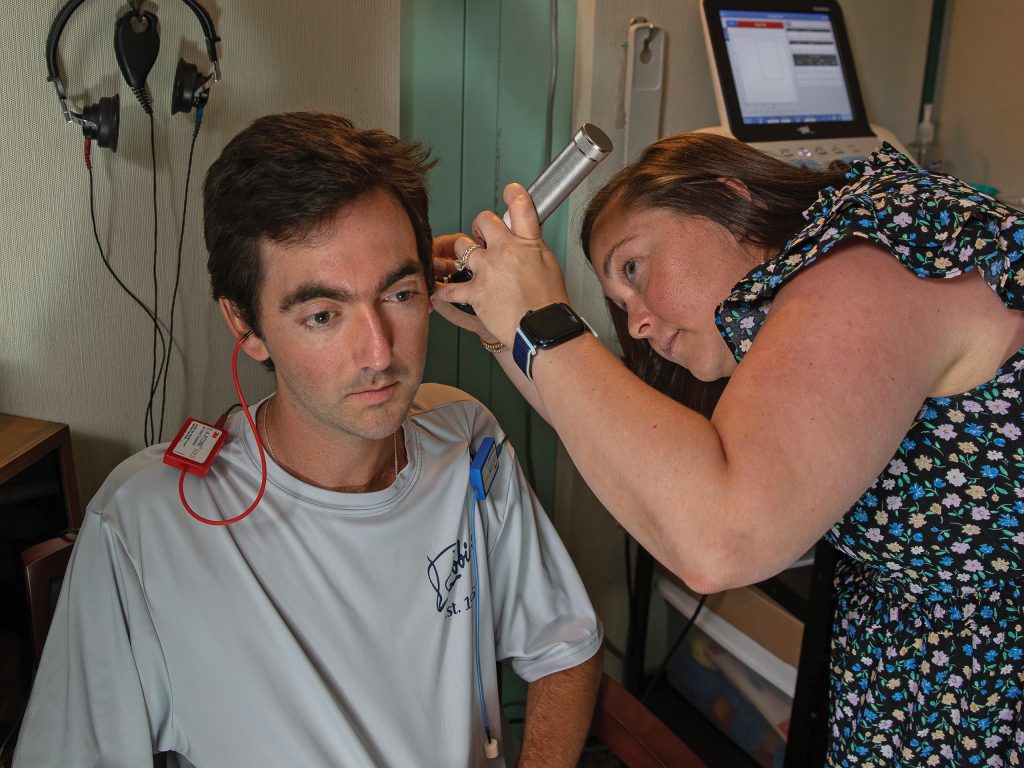
Age-related hearing loss can wreak havoc on your brain, but prompt treatment may help you stave off the risk of dementia.
Written by Zachary Livingston
Photography by John Alexander
As one of the five basic senses, hearing is instrumental to our experience of the world around us. When it comes to age-related hearing loss, many people tend to think first of the sounds they’d miss: the lilt of a favorite song that brings back memories, the whir of a passing car that keeps us alert, or the voice of a cherished friend that signals good times to come. Losing out on the sounds of life is reason enough to warrant a check-in with an audiologist, but according to local hearing experts, the loss of sound itself can be the opening note to a bitter symphony of changes.
As we age and our hearing naturally deteriorates, this loss is often accompanied by a slew of other harmful effects and risk factors including balance issues, depression, and cognitive decline. Perhaps most notably, the 2024 report from the Lancet Commission on dementia suggests that hearing loss is one of the most significant modifiable risk factors for dementia, accounting for roughly 7% of cases worldwide.
Fortunately, recent advances in the testing and treatment of age-related hearing loss have equipped physicians with the tools to reduce — and, in some cases, nullify — these threats. Experts say the sooner patients start taking their hearing health seriously, the more likely they are to thrive well into their later years.
The Brain on Hearing Loss
Age-related hearing loss, known as presbycusis, is primarily caused by the natural degradation of tiny hair cells in the inner ear. Although there are many risk factors involved — genetics, noise exposure, diabetes — some degree of hearing loss is inevitable for most people. According to the American Academy of Audiology, one in three people over the age of 60 will experience hearing loss, and those numbers increase exponentially as the years tick by. In recent years, however, many audiologists have started looking to another key component of the auditory system to build a better understanding of the broader impacts of hearing loss.
“When you hear, the ear is honestly just a conduit of the sound to your brain,” says Dr. Susan Timna, an audiologist and co-owner at Expert Hearing. As she explains, the auditory portion of the brain is responsible for processing those signals from your ears into the sounds you hear, but when those signals begin to falter, the brain must work harder to compensate, often at the expense of other thinking and memory systems. Recent studies have even shown that hearing loss causes the aging brain to shrink faster as its hearing centers fall into disuse.
These factors, combined with the social isolation that often accompanies hearing loss, can lead to some devastating impacts on quality of life. One 2025 study published in JAMA Network Open suggested that mild or greater hearing loss was associated with a 70% or more increase in the risk of dementia. “The greater the hearing loss, the greater the dementia risk,” Timna says. “Even a mild hearing loss needs to be treated, because the long-term effects of untreated hearing loss are going to lead to earlier cognitive problems.”
Hearing loss can also lead to severe balance issues, as the ear provides critical auditory cues in addition to its built-in balance systems. According to the CDC, falls are the leading cause of injury for adults ages 65 and older, making this a potent threat to the independence and active lifestyle that aging adults desire.
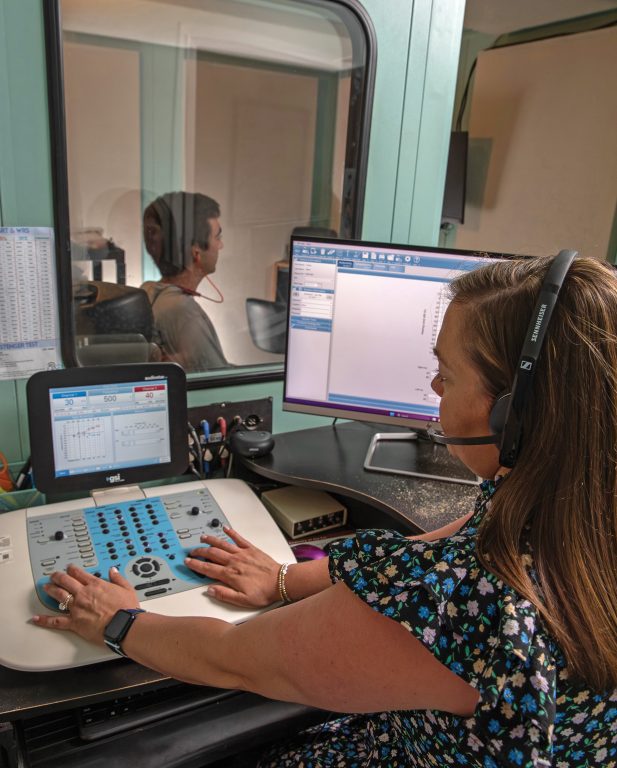
Not Your Grandpa’s Hearing Aids
Thankfully, many of these studies provide evidence that hearing aids are often capable of holding these concerns at bay. That same 2025 study suggested that hearing aid use may mitigate the increased risk of dementia, and in the 2023 Johns Hopkins ACHIEVE study, cognitive decline in participants wearing hearing aids slowed by nearly half over three years. Listening devices can also restore those vital environmental cues, helping the brain orient itself while reducing fall risk.
According to Dr. Casey Boaen, an audiologist at Audiology and Hearing Aid Services, these devices have come a long way, and many people may be unaware of the options available. “Some of my patients in their 50s or 60s think of what their grandparents had years before — these huge, bulky hearing aids that whistled,” she says. “It’s come leaps and bounds just in the last 13 years.”
Modern hearing aids are smaller and smarter than ever, and they often come with rechargeable batteries and helpful add-ons like Bluetooth connectivity to stream audio from a phone or TV. A major upgrade has been the increasing focus on separating speech from noise, a key limitation of older models that focused on amplification alone. For severe cases, Boaen says that cochlear implants may be a viable solution when hearing aids are no longer an option.
Early Signs, Big Impacts
For practitioners, the biggest concern is getting patients into the clinic as early as possible. Hearing loss progresses slowly, and studies show that many people with mild hearing loss are unaware of their changing faculties. Initial red flags — like turning the TV up a little louder or feeling like others are always mumbling — can be subtle, and it’s often a loved one who initially suggests something may be wrong.
Timna adds that cognitive testing has become a key component of her practice, fostering a more comprehensive approach to hearing care that she believes will become the standard in the coming years. “Eventually, all audiology facilities are going to have to do cognitive testing,” she says. “If you don’t, you’re not treating the patient, because you don’t have all the information.” This testing provides a baseline on memory, visuospatial ability, and executive function that can be checked yearly, allowing the physicians to track nuanced cognitive changes that might have otherwise flown under the radar.
And yet, despite all the talk of brain hearing and cognitive decline, it’s often the tiny, overlooked details that aging patients point to when they talk of how treating their hearing loss has helped them savor their later years.
“There are so many environmental sounds that a lot of patients don’t realize they’re missing, so they don’t notice that they’re not hearing the paper rustling or their ceiling fan humming,” says Boaen. “I get a lot of, ‘I can hear the birds again.’ Little things like that are always nice to hear because we take hearing the birds for granted.”