




Local nonprofit Loop It Up brings much-needed cognitive coping techniques to area classrooms.
Written by ALLISON ARBUTHNOT SANDERS
WITH THE CDC REPORTING that children are facing unprecedented rates of anxiety, depression and self-harm, zero-cost tools for supporting mental health and emotional regulation are more important than ever. Anxiety disorders are particularly common in children, affecting about 15% to 20% of children and nearly 1 in 3 adolescents between the ages of 13 and 18, according to the Cleveland Clinic.
One tool for boosting mental health is mindfulness, and it’s now being taught to elementary students in over 400 Savannah Chatham County Public School System (SCCPSS) classrooms through a nonprofit-led program called Mindfulness Zones.
Mindfulness Zones is led by Loop It Up Savannah, a youth arts and educational enrichment nonprofit organization that brings arts-integrated learning to children in the community. The goal is to use mindfulness practices — ranging from movement and art to meditation and breathwork — to foster the development of emotional intelligence, self-knowledge and resilience in Savannah’s youth.
Loop It Up has multiple layers of the program to suit a school’s particular needs, from the simple and most widespread Mindful Monday, which teaches a mindfulness practice of the week, to a full workbook curricula for different age groups. The workbooks are based on storybooks and have accompanying activities such as hands-on expressive art, wellness and breathing practices, yoga and movement and games, all reinforcing mindfulness skills.
Seventeen SCCPSS schools have physical Mindfulness Zone spaces complete with yoga mats and art supplies, and Loop It Up has also begun to set up smaller versions, called Calm Corners, in more schools. Program activities are led through a partnership between teachers, school staff and Loop It Up’s team.
Mindfulness Zones began organically in 2019 when a former principal of Juliette Low Elementary School called Loop It Up.
“The principal was really struck by the fact that if kids got into fights or had disciplinary problems, they would be suspended and return without having gained any skills or strategies for how to solve their problem,” says Molly Lieberman, Loop It Up’s executive director. The principal had read about schools in other communities that taught mindfulness as a tool to combat rising rates of anxiety as well as to address conflict. “Whenever a principal asks me to help them make their school better,” says Lieberman, “I always say yes.”
According to the American Psychological Association, studies have shown that mindfulness techniques such as yoga, breathwork and meditation can reduce stress, anxiety, depression and emotional reactivity, as well as improve cognitive flexibility, memory and focus. These behavioral studies are supported by recent research into the neuroscience of mindfulness, as well. According to the Wharton Neuroscience Initiative at the University of Pennsylvania, the impacts of mindfulness practices can be seen in multiple brain regions, including the cerebral cortex, subcortical grey and white matter, brainstem and cerebellum. Researchers are learning that mindfulness practices can, in time, alter brain function, particularly in periods of stress.
“Deep breathing is Mindfulness 101,” says Jessica Brooks, PhD. She is the director of clinical training at Savannah’s Joye Psychology and Wellness. “It’s powerful biofeedback for the body,” she says. “You can slow down all physical symptoms related to anxiety through your breath. Teaching breathing exercises young is so key because they can be used for your whole life.”
The goal is not to save a child from ever feeling anxious, notes Brooks. “The goal is to teach them that anxiety is a normal part of life, and to give them the tools to get through it successfully.”
Brooks says that anxiety is normal and is a natural motivating force, but when it begins to interfere with functioning, it becomes a problem. Symptoms of an anxiety disorder in children include chronic avoidance, negative self-talk, perfectionism and outbursts of anger.
“When we are thinking about a diagnosis of a disorder, we consider how frequently the behavior is happening,” says Brooks. “If the behavior is really big, like throwing things when they’re mad, but it’s only occasional, then potentially that’s not interfering with anything else. But when the behavior is impacting their schoolwork, friendships, relationships at home or how they view themselves, then that’s when we would recommend a diagnosis and therapy.”
Haleigh Kaht, a licensed professional counselor at Joye Psychology and Wellness, works with the practice’s youngest clients, ages 7 and younger. She uses therapies such as coloring, grounding techniques, like a body scan or progressive muscle relaxation, and breathwork. “There are a lot of creative deep-breathing techniques for kids,” says Kaht. “I tell them, ‘Hold an imaginary cookie in front of your face. Now take a deep inhale through your nose and smell the cookie. Okay, now blow on the cookie; it’s too hot!’”
Mindful movement practices like yoga are tools that can last a lifetime, says Brooks. “When we’re overly stimulated or dysregulated, often we’re not really present, so grounding techniques can be helpful. Yoga gets us back into our bodies. It’s present-focused. When a person is anxious, they are often thinking about the future. Usually when a person is sad, they are thinking about the past. Mindfulness teaches us to recognize and accept what’s happening in the present moment.”
Upon establishing the first Mindfulness Zone at Juliette Low, teachers and Loop It Up staff immediately saw excellent results.
“Kids are learning these skills and using them in real time,” says Lieberman. “We saw them teaching each other how to use them. We saw marked improvements for students who had been having disciplinary issues. Some of them started to have less problems after learning strategies to calm down. They became better communicators by expanding their vocabulary around how they feel and why.”
With an early learning and elementary school curriculum in place, Loop It Up is now developing a middle and high school version of the program. They are expanding the program beyond Chatham County, too, to broaden their impact.
“When we started working with schools, we were focused on Title 1 schools, which are most of the schools in our district,” Lieberman says. “At this point, we realize that everyone will benefit from this, not just a specific demographic of students. We’ve opened it up to serve any school that wants to work with us. Mindfulness is for everybody.”
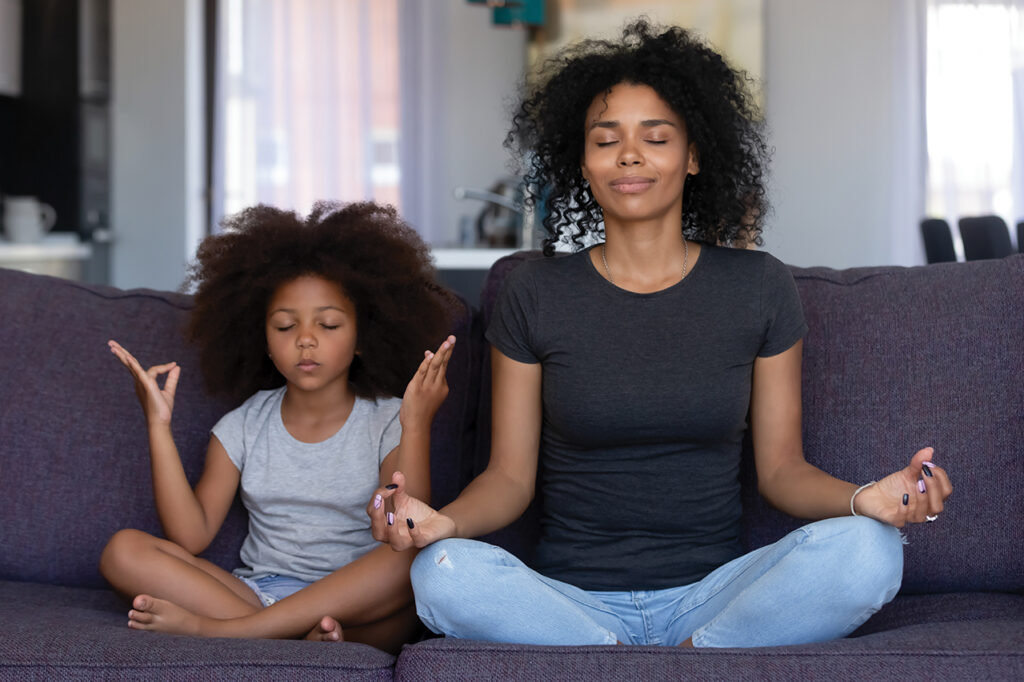
Practice Mindfulness as a Family
Three family-friendly spots to foster mental health:
- Tybee Yoga and Healing Arts holds all-ages community beach yoga classes March-November. Its Kidding Around yoga-certified class for children ages 3-12 is by appointment.
- Yoga in the Moment offers family-friendly yoga classes and children’s yoga classes by appointment.
- Clearing House Savannah has several all-ages mindfulness class offerings, including chi gong, drum circles and conscious dance.
Become Psychologically Flexible
“If we are not armed with ways of understanding our internal world, that is, our thoughts and feelings, and various methods for managing what life throws our way, we can find some not so helpful methods for managing day-to-day life,” says Kristi Hofstadter-Duke, PhD. She is a pediatric psychologist and owner and director of Savannah Behavioral Pediatrics.
She notes that developing the skills of psychological flexibility allows us to approach life’s challenges in a way that is mentally healthy and leads to personal fulfillment. According to Hofstadter-Duke, psychological flexibility involves three things:
- Being open to our internal thoughts and feelings
- Becoming aware of our present-moment experience
- Staying engaged in living in a way that is aligned with what we care about
“These are practices that help us cultivate flexibility in the face of adversity,” she says. She suggests that parents can help teach this to children by modeling healthy management of a wide range of experiences. For example, Hofsteadter-Duke says parents can point out uncomfortable internal experiences like frustration and disappointment, and talk about how they handled them. “We want to normalize the full range of human emotion and talk about ways to allow those emotions to exist while still doing what matters or what is needed next.”