


Local coastal-based education programs are teaching about environmental stewardship and marine conservation.
Written by KA’DIA DHATNUBIA
WHAT’S IN AN OYSTER? Meat if you’re hungry, pearls if you’re patient. For centuries, these native creatures have been providing so much to the eastern coasts. Ben Wells, a marine science teacher at Oglethorpe Charter School, is helping lead a new generation to ensure our beautiful coasts and the creatures that inhabit them are here for many centuries more.
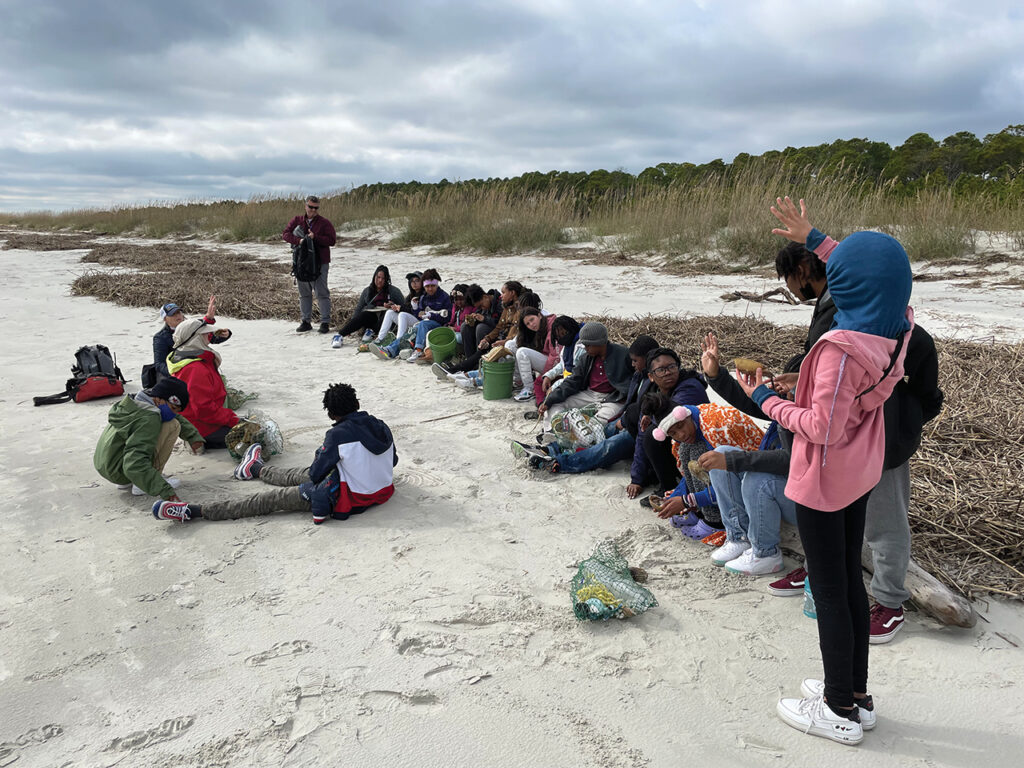
With 25 years of experience as a teacher, Wells’ most recent venture involved starting a marine science program at Oglethorpe Charter School. Sixth graders are required to take oceanography to expand their horizons and expose them to topics they may not even know they’re interested in. Seventh graders have the option to take biology and statistics, while eighth graders have Georgia history standards and barrier island ecology. Each year, as part of the curriculum, Wells takes a select group of students on a series of field trips around coastal Georgia: two in the fall and two in late spring.
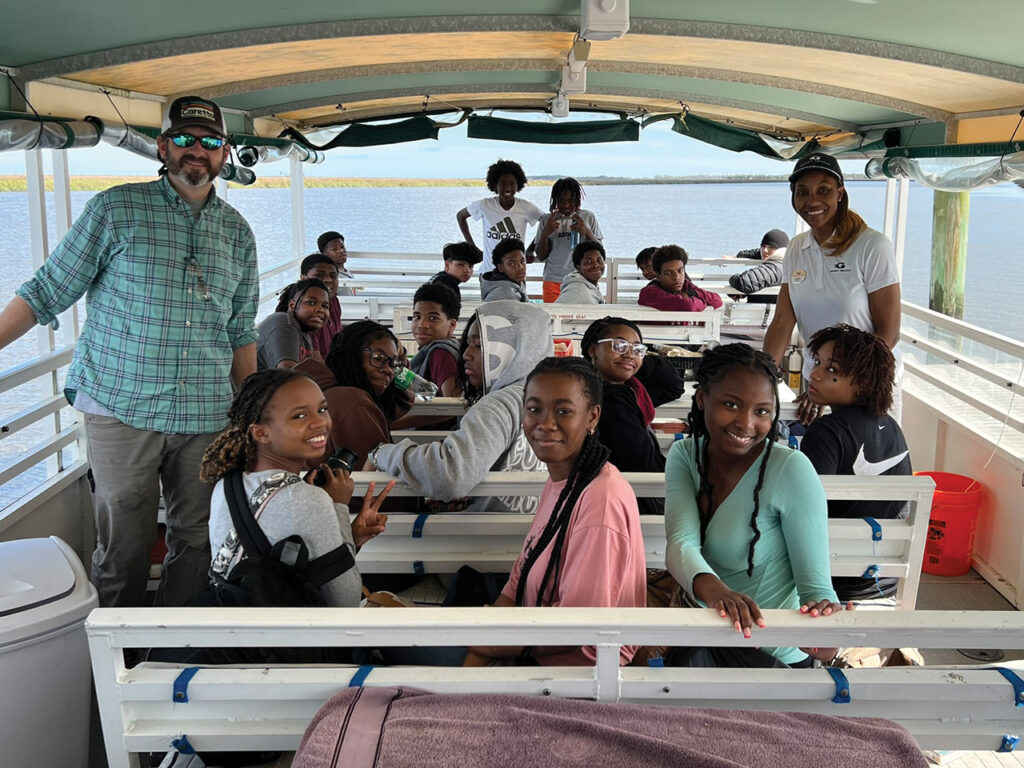
Meanwhile, Lindsay Patterson joined the Georgia Aquarium as their education programs manager and regional coordinator in September 2023, tasked with establishing the first Ocean Guardian School in Georgia for the National Oceanic and Atmospheric Administration (NOAA). While there were more than 90 schools across the U.S. and its territories designated as Ocean Guardian Schools, there were none at that time in Georgia.
Patterson and Wells were able to connect and they discussed what projects they could collaborate on. “Ben’s just one of those get-after-it educators,” Patterson says. “He has a deep connection with his students.”
Wells told Patterson about one of his field trips to Ossabaw Island, and the two teamed up.
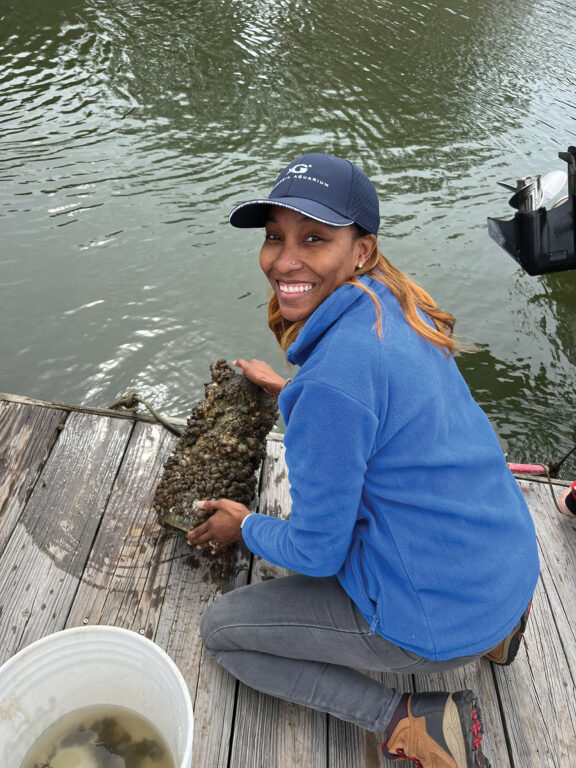
“My job was to basically take his project and tease it out into a schedule with objectives and metrics that have to be sent back to NOAA,” Patterson explains. She also facilitated supplies, funding for the field trips and anything else to aid the project. After synthesizing the students’ observations into data for the report and application, Patterson passed the information to the NOAA-affiliated Gray’s Reef Marine Sanctuary. At the end of the 2023-24 school year, they submitted the final report, and Oglethorpe Charter was designated as an Ocean Guardian School in October 2024.
The school’s five-year project is called “Oglethorpe Oysters: Marshing Through Time.” The purpose of the project is to examine, educate and contribute to the multi-faceted eastern oyster Crassostrea virginica use on the northern Georgia coast. Essentially, Wells explains, the students are looking at uses of oysters by indigenous people, specifically on Ossabaw Island, where there is a shell ring — a remnant from an early Native American village — and some tabby cabins that were later built by enslaved African people. Tabby is a masonry building material made of sand, lime (created through the burning of oyster shells), oyster shell aggregate and water.
Some of Wells’ students are connected to Georgia’s barrier islands by ancestry, with relatives who lived in a tabby cabin or worked making nets on the Georgia coast.
As part of their program, students visited Pin Point Heritage Museum and spoke with Hanif Haynes, a descendant of enslaved Africans who worked at Middle Place Plantation on Ossabaw. After a series of hurricanes in the 1800s, Haynes’ ancestors — skilled in crabbing — established an oyster factory on Pin Point, which today houses the museum. Gail Smith, the museum’s historical interpreter, also joined the young people during their tour.
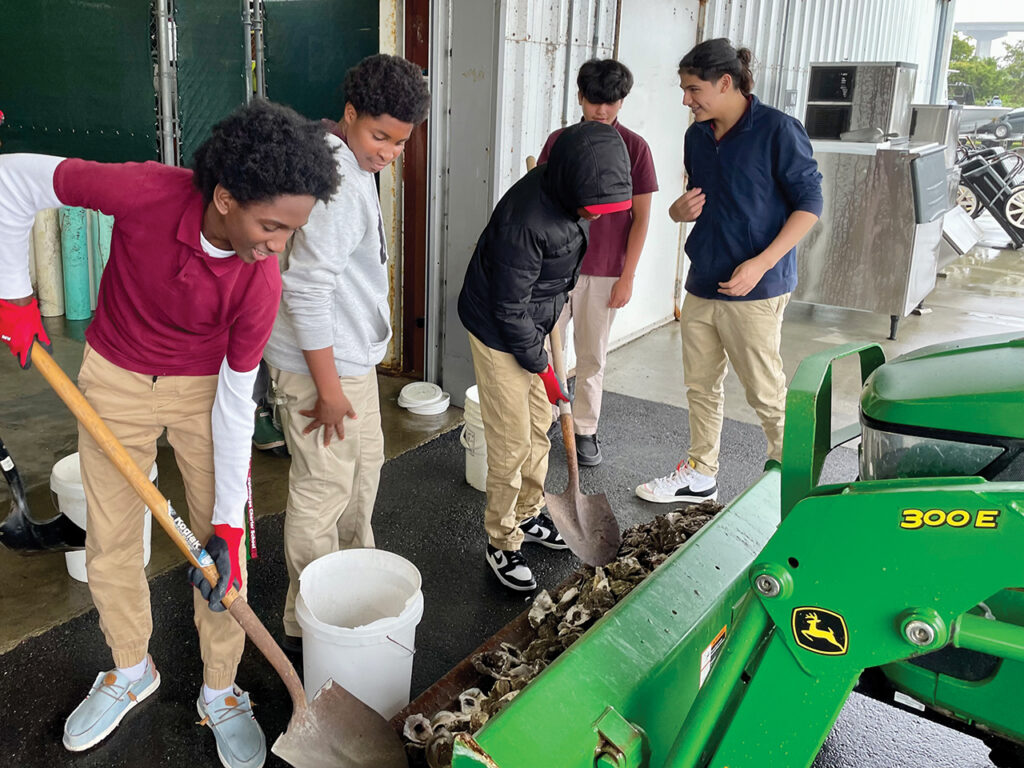
When it came time to map out living shorelines around the barrier islands and coastal regions, Wells reached out to the Georgia Department of Natural Resources (DNR). “That’s one of the fun things about this project: It has opened up some doors we hadn’t gone through before,” Wells says. With the DNR’s resources, the students collected several bags of oysters and loaded them into tractors to create living shorelines. Shorelines made from natural materials are better for the environment, as opposed to armored shorelines, created with riprap (broken concrete) or wooden sea walls.
“When the sea level is rising, if you’re armoring your shoreline with something hard like that, there’s nowhere for the marsh to go, and that wave energy is going to move down the seawall, causing more erosion,” Wells explains. Building reefs with oysters, however, creates environments for small fish and invertebrates, disperses the energy of the waves and builds up the salt marshes over time.
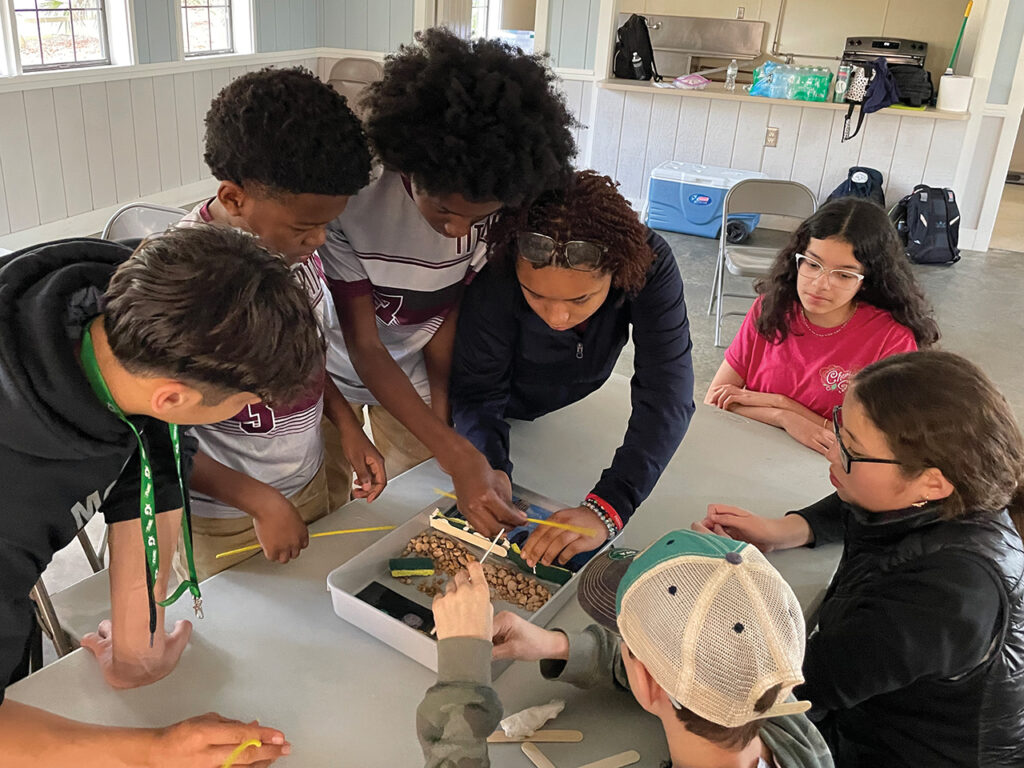
This is one of many ways Wells and Patterson are teaching young people to care for and protect their environment. Climate change can feel like an insurmountable problem, and worrying about the latest weather events adds to that feeling of powerlessness. But programs like the Ocean Guardian School and Wells’ field trips and projects help students understand that they can personally make a positive and direct impact.
“There’s no place I feel more at home than out on a barrier island, smelling the marsh, seeing the beach,” Wells says. “It’s that old Jacques Cousteau thing that 1,000 other people have quoted, ‘You protect what you love.’”
Hands-on, Feet-in Approach
IN OCTOBER 2024, Savannah’s own Katie Higgins was named Educator of the Year at Georgia Association of Marine Education’s annual conference. As a member of University of Georgia’s Marine Extension and Georgia Sea Grant education team, Higgins facilitates workshops for thousands of pre-K through twelfth grade students who visit the aquarium each year. Higgins calls it a “hands-on, feet-in approach” that gives students experience with live animals, scientific methodology and observing natural phenomena.
She has also extended this to outreach programs and teacher trainings, noting that youth is a state of mind. “The same teaching techniques that work for K-12 students work well for adults, whether teachers, tour guides or volunteers,” Higgins says. Even if folks come into her program knowing little about marine science, it’s all about fostering a strong sense of curiosity. “Teaching science starts by encouraging others to ask questions and to discover creative ways of finding answers.”
For Higgins, education is her way of protecting what she loves. “Teaching others about the incredible biodiversity of the Georgia coast and the ecosystem services provided by the coastal habitats is my way of contributing to the health and resilience of the place I call home.”
Adapting for a Changing Future
SEVENTH GRADE STUDENTS at Tybee Island Maritime Academy (TIMA) have been hard at work creating a plan to combat rising sea levels. They are preparing to enter the national Future City competition for middle school students. Joel Clackum, who teaches ELA at TIMA, explains, “The students spent time exploring the natural structures of barrier islands to think about how nature’s solutions might shape the engineering that will be needed for their cities.” This experiential education extends to meeting with Tybee city government officials to discover ways to develop infrastructure that prevents flooding, preserves coastal ecosystems and defends against the dangers of rising sea levels.
Meanwhile, TIMA eighth graders are examining the entrepreneurial opportunities that work with and for the environment. After meeting with local business owners, students brainstormed ideas that fulfill the needs of their community and their environment. Clackum lists a few of their concepts: “marine-based alternative power, nonprofit services to protect the marshes, and creating businesses like a sustainably sourced food truck that would specialize in fresh, local seafood.”
The school’s sixth graders studied ocean currents and winds, then used that research to design devices that use wind and water to collect and remove trash from the coast. Some of these students are even collaborating with Georgia Southern University to measure and record data on dune restoration and bird species on Tybee Island beaches. TIMA’s Megan Heberle, who teaches sixth grade math and science, says the hands-on approach “not only enhances the students’ understanding of environmental restoration but also strengthens their connection to the local ecosystem and their role in preserving it for future generations.”
New Chapter at a Beloved Camp
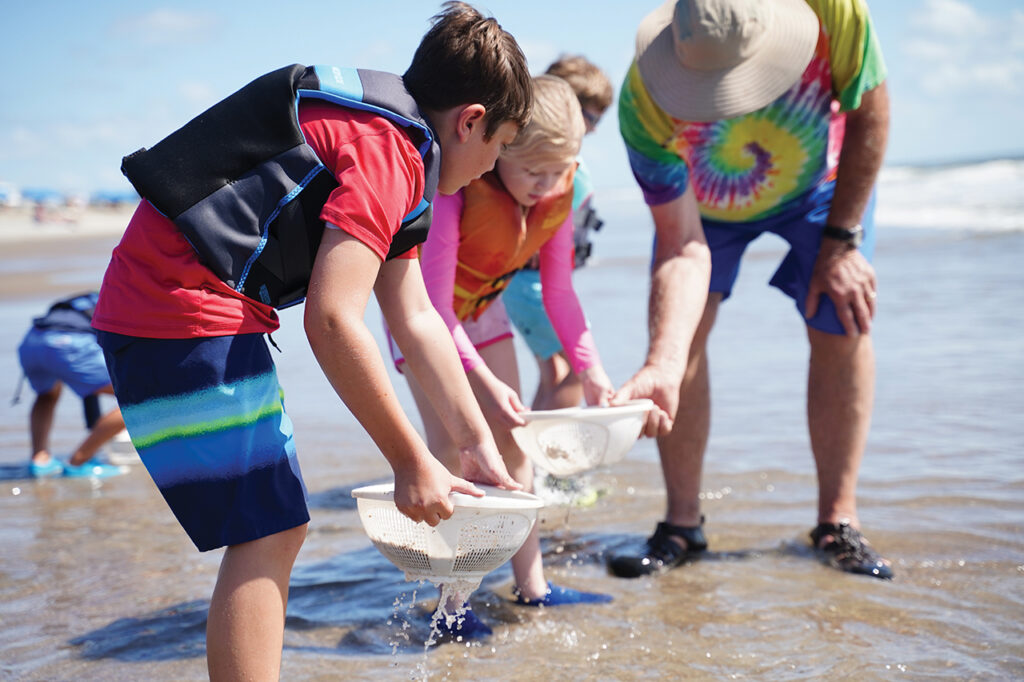
SAVANNAH COUNTRY DAY SCHOOL‘S popular summer Coastal Ecology Camp — open to area students who are rising kindergartners through rising seventh graders — lets kids get their feet wet in the local marshes and waterways. Coastal Ecology is a four-day camp (Monday to Thursday) that runs five times over the course of the summer.
The camp allows youth to explore various ecosystems, including freshwater, saltwater and brackish habitats, to learn about environmental stewardship and marine conservation. Campers are encouraged to build knowledge and collaboration skills through team-based problem-solving tasks, while documenting their discoveries in their journal. The camp culminates each week with a trip to Sapelo Island to visit unspoiled coastal landscapes.
Bill Eswine, the camp’s leader of 42 years, recently passed the torch to Andy Wiley, Country Day’s middle grade science teacher. Wiley has a master’s degree in environmental management and 15 years of teaching experience, preparing him to carry on Eswine’s coastal education legacy.
While Wiley will no doubt bring his own spin, the purpose of the camp remains the same. “Through integrated storytelling, campers are exposed to the region’s cultural history and connected with the human dimension of coastal conservation,” Wiley says. “Outdoor, hands-on learning creates a memorable connection for young students between new knowledge and the environment they encounter every day with their families.”