




A tattered gun battery is transformed into a home that celebrates the natural beauty of Tybee Island

JUST BEYOND THE DUNES of Tybee Island’s northern
shoreline stands a relic of the Spanish-American War. Battery
Backus, an Endicott Period gun installation from the 1890s, was
tasked with sinking any unauthorized ships that tried to enter
the Savannah River. Now, in 2021, those cracked cement steps
no longer lead to mortars and magazines but instead to the cozy
home of two avid environmentalists.
“Originally, I had said, ‘Let’s just throw a tent up there,’”
recalls Kathryn, one of the homeowners, smiling at the memory.
What she and her husband, Ed, hadn’t realized was that the architect
they hired to design the project, Dan Snyder, always pays
attention to little details like that — details that would be subtly
woven into the finished framework of the home.
“When you start something like this you have two issues to
satisfy,” says Snyder. “It was important to sustainably preserve the
memory of this place, but the clients needed a home that really
satisfied their hearts, too.” Snyder stands over the process books
and blueprints in his office, flipping through dozens of different
sketches, before landing on the final concept.
“The house reiterates the harsh, angular lines of the battery,”
says Snyder. “There’s a sort of brutality in this concrete. It’s
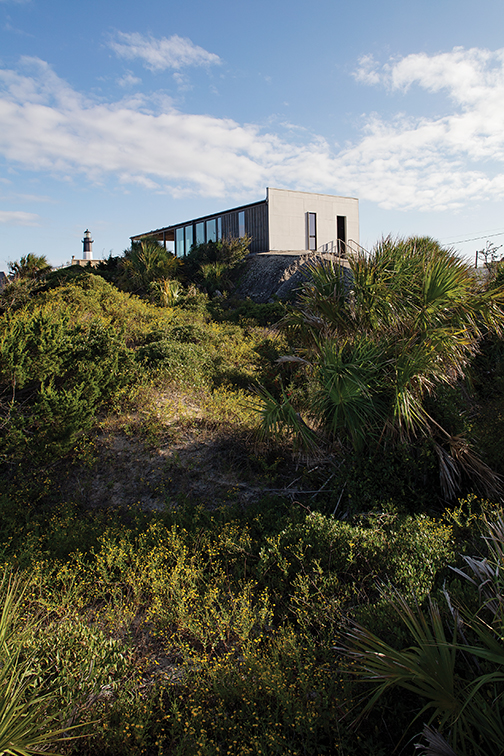
almost mean. Rough yet sublime.” Perched atop the historic,
sharp-edged foundation, sits a rustic rectangular frame.
Exposed wood, iron rails and a blank, white exterior bridges
the new to the old.
“You can make something beautiful very simple,” says Ed.
Solar panels are hidden flat across the roof. The small storage
garages are closed off with locks and weathered metal doors.
A narrow beach trail curls around the crumbling edges of the
battery’s end. From the street, the house looks stark, and intentionally
so. That way, when Ed and Kathryn enter their front
door, it feels as if they have crossed a threshold to another world
— their world.
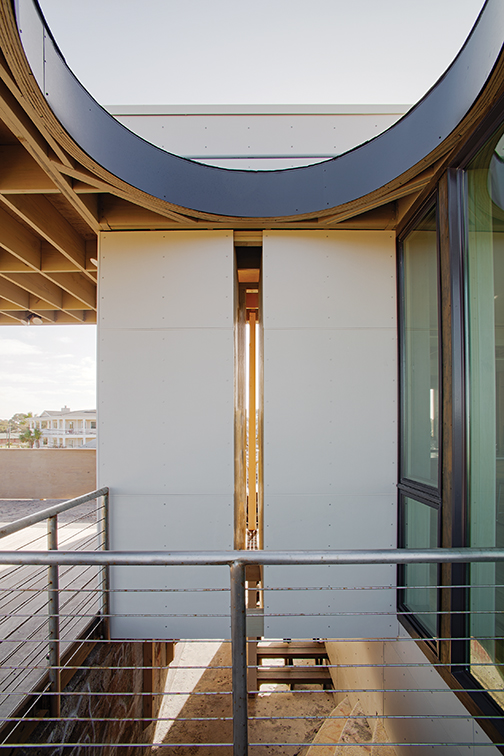
During the ascent up the front steps, a small viewing slot was
created, offering a glimpse of the ocean between the boards. Once
inside, that glimpse opens up to a living room lined with 9-foot,
floor-to-ceiling windows that display a panoramic seascape: complete
with vistas of both the shore and the river inlet. “I like this
sort of two-fold presentation,” Snyder adds.
Despite the outdoor grandeur, the living room revolves around
Kathryn’s antique centerpiece: a glass-topped table in the shape of
a snail. Ed’s binoculars are always resting there, next to a stack of
titles from their ever-growing book collection. To the right, hardwood
flooring follows the curved outline of the old cement gun
emplacement, still visible and flush with the rest of the room.
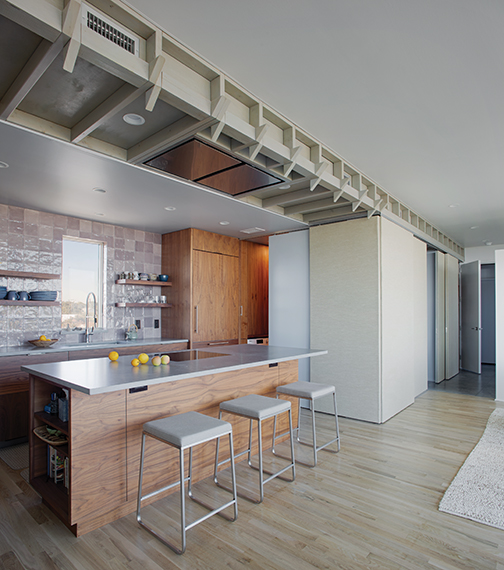
The open kitchen is seamlessly woven into the other common
areas, designed with a floating island that features a built-in stove
top and barstool seating. A slender counter, outfitted along the
back wall, houses the sink, framed by robust wooden shelves and a
window that overlooks the Tybee neighborhood.
If one were to look up, they would find an interlocking wooden
soffit, affectionately known as “the zipper,” running the length
of the ceiling, from the front door to the master bedroom. Not
only does it visually lead a guest through the home, but it also
ties it together, like the two flaps of a tent. It’s thought-provoking
accents like this, in Snyder’s design process, that add a unique and
personal charm to the fully rendered space.
Following the zipper, ample storage and pantry space can be
found behind sliding dividers, cleverly disguised as a wall. The
master bath, on the other side of the storage wall, draws upon
the fort’s aesthetic, incorporating a walk-in shower composed of
exposed wood and translucent fiberglass. Ed’s at-home office is
tucked into a nook just before the master bedroom, where the zipper
eventually ends. Here, the room boasts its own scenic views.
On closer inspection, Ed points out how the ceiling is shaped like
wind-rippled canvas.
“But this is why they’re there,” says Snyder, opening up his
site analysis binder to a particularly stunning photo of nighttime
on the beachfront. Knowing this site isn’t only meant to
be enjoyed from the inside, Ed and Kathryn made one last addition
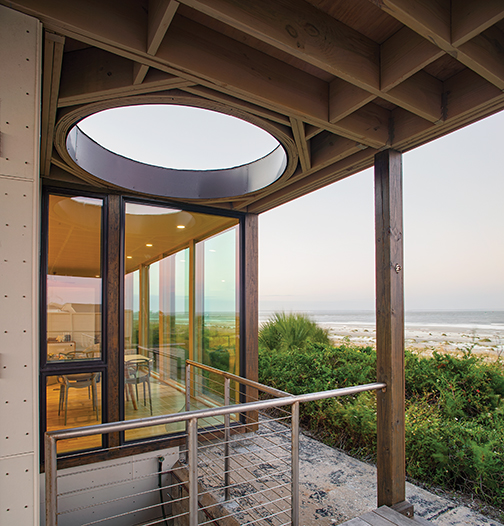
to their beachfront residence: an elevated porch with an
umber-stained, wooden pergola overhead. To the left, a handbent
oculus captures a moving vignette of rolling clouds and
infi nite sky.
“The house is subtle, quiet, humble and caring,” says Snyder,
piling his journals, solar calculations and wind diagrams into a
neat stack. “When I say caring, I mean caring for Ed and Kathryn,
caring about the battery, caring for the broader place of Tybee and
caring about the Earth, as a whole.”

