




What do Georgia’s cellphone bans mean for Savannah-area students?
Written by Walinda P. West
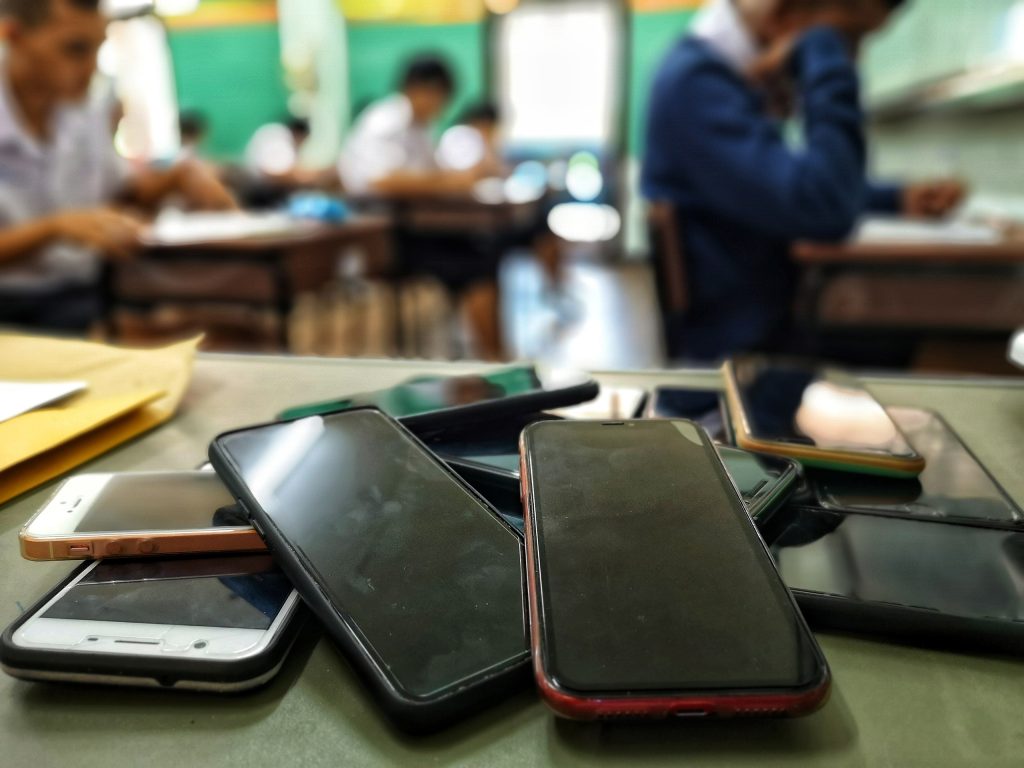
With Gov. Brian Kemp signing new legislation expanding restrictions on personal electronic devices in public schools, students across Georgia, including those in Savannah, are preparing for a different classroom experience. House Bill 1009, which Kemp signed into law in May 2026, extends the state’s existing “bell-to-bell” cellphone restrictions to public high schools beginning in the 2027–28 school year, building on earlier statewide limits for elementary and middle schools.
In 2025, Kemp had signed House Bill 340, creating a law that would prohibit K–8 students in public schools from using electronic devices such as cellphones, tablets, and smartwatches during the school day by July 2026. Public schools were required to come up with a plan for implementation by January 2026.
As HB 340, also known as the Distraction-Free Education Act, goes into effect across the state July 1, 2026. Kemp framed the new policies as part of a broader effort to improve academic outcomes.
“Our classrooms must be safe learning environments that serve as launching pads for success in the workforce,” Kemp said in remarks during the signing ceremony for HB 1009, adding that the legislation aims to reduce distractions while supporting educators and families. For our local schools, the laws represent more than a statewide mandate. They signal a cultural shift in classrooms where educators, parents, and students are grappling with questions about attention, mental wellness, communication, and safety.
A New Reality for Coastal Georgia Schools
The Savannah-Chatham County Public School System (SCCPSS) has already begun adjusting to stricter expectations around student device use ahead of the state’s mandate. Recent district policy updates emphasize reduced access to phones and other personal electronic devices during the school day as part of an effort to create what Samantha King, director of instructional technology and media services for SCCPSS, describes as a “safer, more focused learning environment.” This fall, all SCCPSS students are generally expected to store devices during the full school day. “It’s important because we want students to be fully immersed in the education, engaged with their peers, and fully present,” says King.
Private Schools Also Respond
At Savannah Country Day School, phones and tablets have long been restricted in the lower and middle schools. During the 2024–25 academic year, the upper school adopted a policy requiring students to secure phones in pouches after morning advisory. “Smartphones can interrupt focus and shape social dynamics in ways that aren’t always healthy,” said Kef Wilson, head of school. “This policy helps students be more present with themselves, with each other, and with their learning.”
St. Andrew’s School requires lower and middle school students to keep phones powered off during the school day, while upper school students place devices in designated locations.
“This allows students to focus on the skills and learning central to their academics and personal development without the constant interruptions of personal communications and social media,” says Maria Dixon, the school’s director of marketing.
Across coastal Georgia, schools are experimenting with classroom storage systems, schoolwide limits, and full bell-to-bell restrictions, all aimed at curbing digital distractions.
The Push for Fewer Distractions
Supporters of cellphone restrictions point to a familiar challenge in modern classrooms: divided attention.
Smartphones place social media, streaming platforms, messaging apps, and games within arm’s reach. Educators across Georgia report classroom-management challenges tied to device use, from interruptions during instruction to conflicts that begin online and spill into hallways and cafeterias. State lawmakers argue that limiting access may improve concentration, reduce disruptions, and encourage more face-to-face interaction.
The policy changes in Georgia are part of a broader national shift. Districts across the country are rethinking the role of smartphones amid concerns about attention spans, cyberbullying, and student mental health.
A recent study from the National Bureau of Economic Research found that schools using lockable phone pouches often experienced a difficult first year, including declines in student well-being and increases in disciplinary incidents. Over time, however, student well-being improved and disciplinary effects faded, while academic gains remained modest and uneven.
A Generation That Grew Up With Smartphones
Today’s students have never known school without smartphones. For teenagers, phones function as planners, entertainment hubs, cameras, social spaces, and sometimes emotional lifelines. That reality complicates the debate.
Supporters of restrictions argue that constant connectivity comes at a cost during instructional hours. Critics worry about emergency communication, after-school coordination, and whether older students, particularly those involved in athletics, work-study programs, or dual enrollment, may require more flexibility. HB 1009 allows districts to establish policies for exceptions and off-campus instructional needs.
Parents accustomed to texting their children throughout the day may also need to adjust to delayed communication, while schools could face pressure to clearly explain emergency notification systems and dismissal procedures.
More Conversation or More Frustration?
The long-term effects of Georgia’s cellphone restrictions remain difficult to measure, particularly in high schools where the policy has yet to take effect.
Still, schools that have piloted tighter controls often report subtle shifts: more student interaction, fewer classroom interruptions, and increased teacher engagement.
Whether those changes translate into meaningful academic gains remains unclear.
In Savannah, where schools can reflect a blend of urban, suburban, and rural experiences, implementation will likely vary. A large public high school may face challenges very different from those of a smaller charter or specialty school, and what works in one setting may require adaptation in another.
Still, one thing is increasingly clear: The era of unrestricted classroom scrolling appears to be fading.
And in coastal Georgia, a new question is emerging: not simply whether students can succeed without their phones for seven hours a day, but what school life may feel like without their devices.