


The hotel was originally a bank and then a City of Savannah office building before its glorious restoration.
Written by Mary Fitzgerald
Midcentury modern is not the most widely recognized architectural style in Savannah, but it is a significant one, marking a pivotal chapter of change during the 1950s and ’60s. If you look around, you will see examples of this modernist movement throughout the city, realized in both commercial buildings and residential homes. Defined by clean lines, a minimalist sensibility, and the raw materiality of wood, stone, metal, and glass, this architectural style exemplifies modernism’s focus on form and function.
Endangered Spaces
During the post-World War II era of economic rebuilding, many of Savannah’s vacant and dilapidated buildings were leveled and replaced with modern structures. While some remarkable properties were lost — including the original Victorian-style DeSoto Hotel, which was demolished in 1966 and rebuilt in the midcentury modern style in 1968 — this period ultimately helped ignite Savannah’s preservation movement.
“Savannah’s robust historic preservation efforts were born out of the development pressures and demolition of the mid-20th century,” notes Collier Neeley, president and CEO of the Historic Savannah Foundation. Today, midcentury modern architecture is facing a similar threat of extinction. “We’ve recently lost buildings at the corner of Whitaker and West Park Avenue,” says Neeley, “and will soon lose the Seabolt Realty offices, too.” [Located on Oglethorpe Avenue, the building has been approved for demolition.]
But there are still notable examples of midcentury modern design to be seen and appreciated in Savannah, including Levy Jewelers and Savannah College of Art and Design’s Jen Library on Broughton Street; Drayton Tower on Liberty Street; the Sears building on Henry Street; and the Thunderbird Inn and the Oglethorpe House (formerly the Downtowner Motor Inn and now a SCAD dorm) on Oglethorpe. The Civic Center is another example, though it is slated for significant renovation and redevelopment.
Savannah architect Andrew Lynch, whose firm has been instrumental in restoring many midcentury landmarks, notes the importance of saving the modern style and preserving its place in history. “It shows the progression of architecture in the city from the more historic architecture to a more modern methodology,” he says. “To me, the juxtaposition of the midcentury architecture against the more historic architecture in town makes it that much more distinctive.” But he acknowledges that not all buildings can be saved, especially if they have been significantly altered over the years or have fallen into total disrepair.
A High-Profile Example
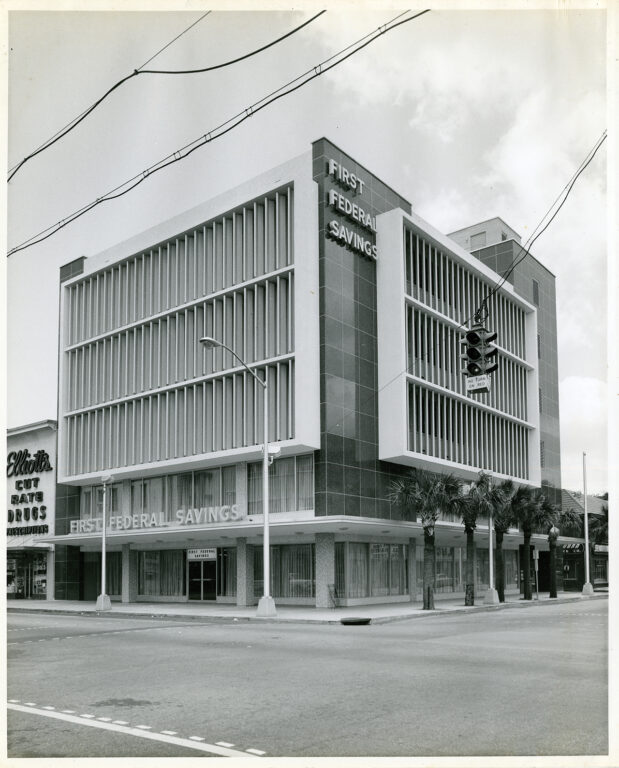
One recent success story is the Municipal Grand Hotel and Bar, first repurposed from a bank to a city office building before its current iteration as a boutique hotel. Located on the corner of Broughton and Abercorn streets in Savannah’s National Historic Landmark District, the thoughtfully designed Municipal Grand opened in July 2025 and boasts six floors, 44 boutique-style rooms, a cocktail-driven lobby bar and restaurant, a rooftop pool and lounge, and an intimate subterranean cocktail den called The Hot Eye. The impressive transformation is befitting of the building’s unique architecture and storied history.
Originally designed by Levy & Kiley — a prominent Savannah architectural firm known for its modernist work — the building opened its doors in 1961 as the First Federal Savings and Loan Association. In 1991, the City of Savannah purchased the former bank to be used for municipal offices but sold it off as “surplus property” in 2018.
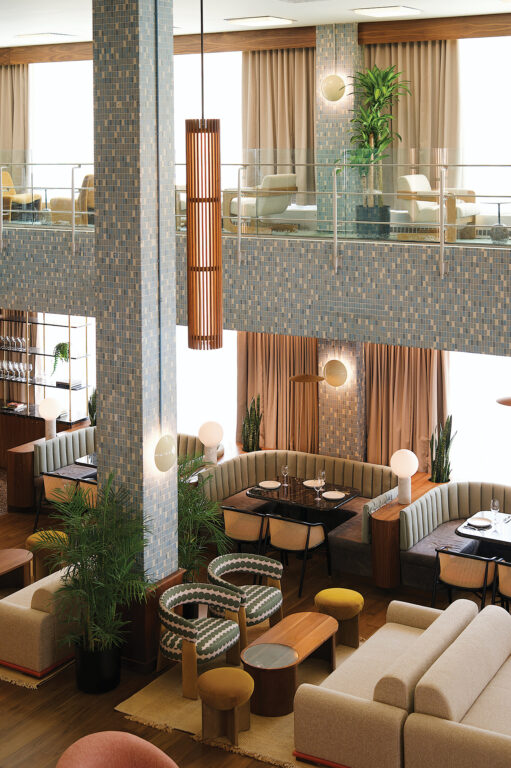
The current owner, hospitality group Midnight Auteur, acquired the property in 2022 and assembled a team of design professionals to restore the building’s midcentury character. Lynch Associates Architects of Savannah served as the architect of record, while AAmp Studio — based in Portland, Maine, and Toronto, Ontario — led the interior design. AAmp had already collaborated on several other projects with the hospitality brand, including the Ramble Hotel in Denver and Death & Co. locations across the United States. Ward Architecture + Preservation, local preservation specialists, handled the National Park Service certification and tax credit process. [The National Park Service is the federal agency that issues a certification verifying the rehabilitation meets all preservation best practices.]
Describing the building as “very modernist and quite composed,” Anne-Marie Armstrong, principal and co-founder of AAmp Studio, highlights the prototypical elements of granite, concrete, tile, and glass on the facade and interior finishes of terrazzo flooring, brushed aluminum railings, and wood veneer wall treatments. During the restoration, blue mosaic tile was uncovered on the lobby columns and mezzanine half walls; it had been concealed beneath beige vinyl laminate. That tile is now celebrated as an integral part of the overall design.
“We were really cognizant not to repeat details but to honor them and to be in conversation with them,” says Armstrong of their material selections. AAmp Studio co-founder and principal Andrew Ashey explains that in order to be compliant with National Park Service rules, “anything we did to the building that was new couldn’t outright mimic, replicate, or be in conflict with what was already there.” The team salvaged and preserved as many of the features of the building’s banking days as possible, including walnut teller counters and the original bank depository and vaults.
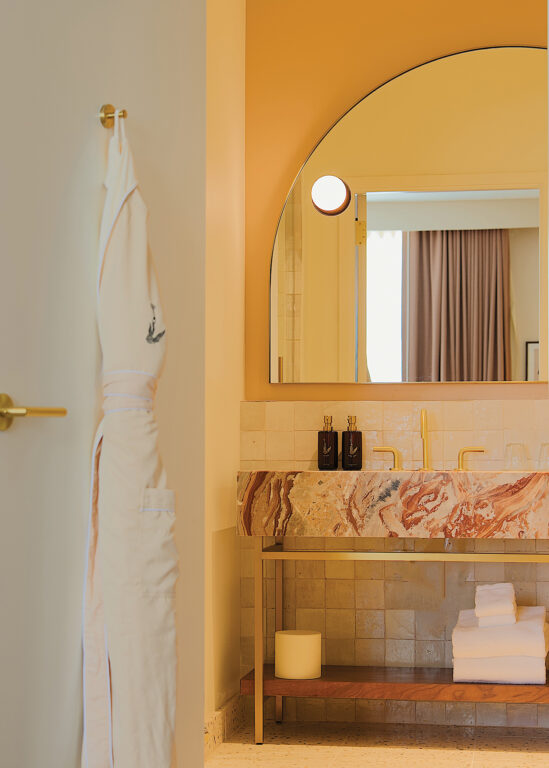
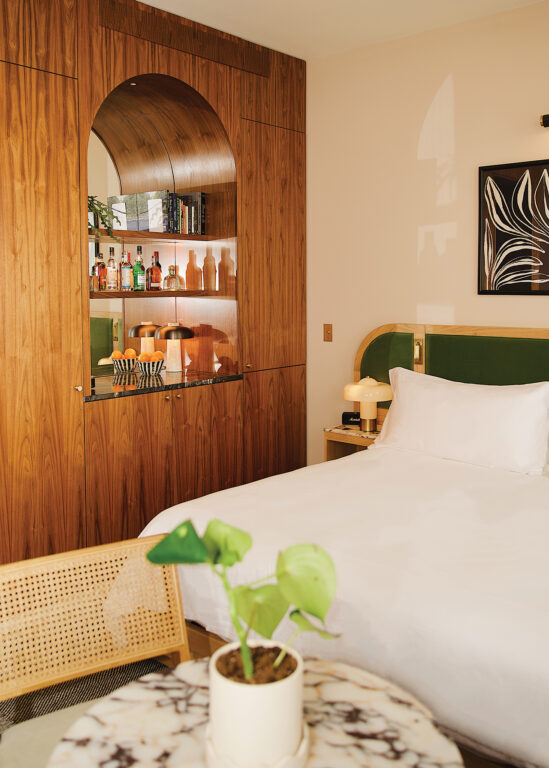
“Midcentury design is extremely rectilinear,” says Ashey, meaning it relies heavily on straight lines. To temper the hard surfaces and create a more welcoming atmosphere, the designers introduced warm velvets, curvaceous banquettes, and a crescent-shaped bar in the lobby restaurant/bar. Upstairs on the guest floors, the designers had more freedom for fixture and furnishing selections and opted for a moody, modern vibe: graphic carpeting, a soft color palette of blush and green, arched walnut millwork, wood-and-velvet headboards, and handmade Moroccan tile and red marble for the bathrooms.
As with any adaptive reuse project, there were obstacles, especially while repurposing an office space into a hotel. Lynch notes that some of the biggest challenges were things you won’t see. The building wasn’t code compliant for today’s standards, so new elevators and shafts and a secondary egress were installed. All the major systems — HVAC, electrical, and plumbing — had to be replaced without disturbing historic details. Adding a pool on the rooftop required structural reinforcement and a set-back placement so as not to disrupt existing site lines from the street.
The collaborative team succeeded in preserving the integrity of the building’s midcentury design, demonstrating a deep respect for the original architects, the history of the building, and the community. Levy & Kiley would likely be pleased with this latest iteration, which continues carrying their vision forward into a new era.